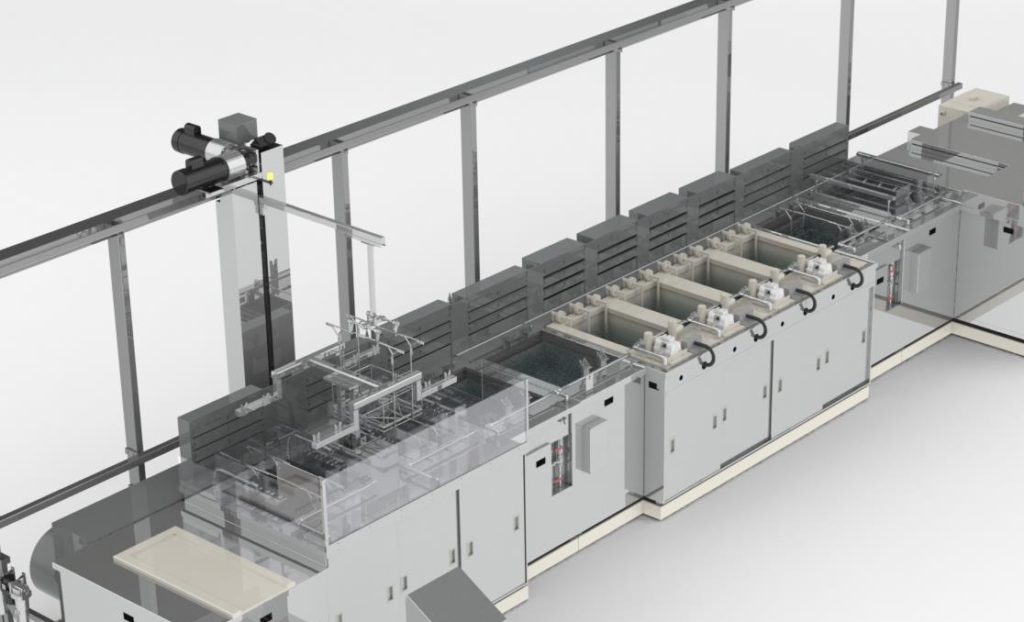
Passivation of stainless steel is a chemical treatment with an acid solution, usually nitric or citric acid, that removes free iron and other contaminants from the surface so the passive film can form fully. Parts that have just been cut, machined, or fabricated regain their full corrosion resistance. Passivation is not a coating: it adds no layer, does not change dimensions, and barely changes appearance.
This guide explains what passivation is, how it differs from pickling, when it is needed, the process steps, nitric and citric treatments under ASTM A967, application methods, standards, how to test the result, common problems, and safety. Stainless steel basics and the passive film are covered in our guide to the types of stainless steel.
What Is Passivation?
Stainless steel resists corrosion because its chromium forms a passive film, a very thin chromium oxide layer on the surface. This film forms on its own in air. The problem is that cutting, machining, grinding, or handling with carbon steel tools often leaves free iron on the surface: tool fragments, shop dust, or particles from work tables. Free iron rusts and can become a starting point for corrosion.
Passivation dissolves free iron and contaminants without attacking the stainless steel. The clean surface lets the passive film form evenly and richer in chromium than before treatment. That is why passivation is often described as “making stainless steel stainless.”
What passivation does not do:
- It does not remove weld heat tint, heat treatment scale, or deep rust.
- It does not remove oil, grease, or cutting fluid; those must be cleaned off first.
- It does not raise corrosion resistance beyond what the grade can offer. Passivated 304 is still not 316.
Pickling vs Passivation
The two terms are often confused, but they do different jobs.
| Aspect | Pickling | Passivation |
|---|---|---|
| Purpose | Removes scale, weld heat tint, and the chromium-depleted surface layer | Removes free iron and contaminants so the passive film forms fully |
| Typical chemistry | Nitric-hydrofluoric acid mix (solution or paste) | Nitric or citric acid |
| Removes metal? | Yes, a thin surface layer dissolves | Practically no |
| Appearance | May become slightly dull or matte | Barely changes |
| Removes heat tint | Yes | No |
| Hazard | High; hydrofluoric acid is very toxic | Moderate (nitric) to low (citric) |
| Standard | ASTM A380 | ASTM A967, ASTM A380 |
The sequence: if there is heat tint or scale, pickle first, then passivate. If the surface is only contaminated with iron from machining or handling, passivation alone is enough. Cleaning welds is covered in our guide to welding stainless steel.
When Is Passivation Needed?
- After machining and fabrication. Tools, drill bits, and dies leave iron particles on the surface.
- After welding and pickling, for welded tanks, piping, and frames.
- Food, beverage, pharmaceutical, and medical equipment, where surfaces must be clean and corrosion resistant. Many specifications in these industries require passivation.
- Precision parts and fasteners in free-machining or martensitic grades that spot with rust easily.
- After iron contamination, for example stainless scratched by carbon steel tools or showered with grinding dust.
- After rust removal, so rust does not return quickly. Rust removal is covered in our guide on how to remove rust from stainless steel.
Household items such as pans and sinks usually don’t need passivation. The passive film re-forms on its own after cleaning, rinsing, and drying.
The Passivation Process, Step by Step
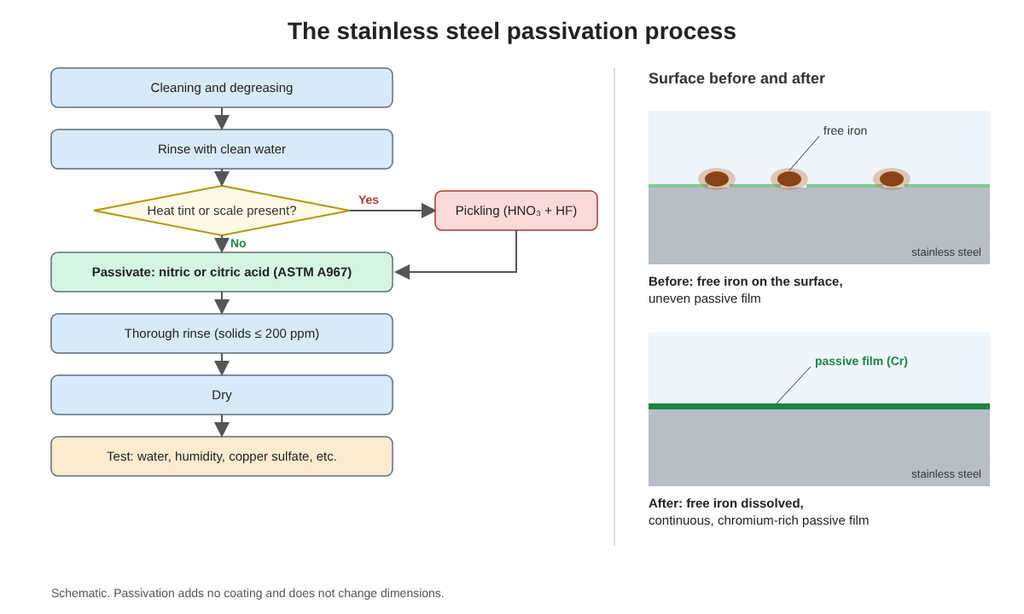
- Cleaning and degreasing. Remove oil, cutting fluid, fingerprints, and dirt with an alkaline cleaner or solvent. Leftover grease reacts with the acid to form gas bubbles that block passivation.
- Rinse with clean water.
- Pickle if needed. Only when there is heat tint, scale, or a thick oxide. Mechanical or electrochemical cleaning can also be used.
- Passivate. Immerse, spray, or apply nitric or citric acid according to the chosen treatment (see the tables below).
- Rinse thoroughly. ASTM A967 limits total solids in the final rinse water to 200 ppm. High-chloride water should be avoided; many practitioners aim for chlorides below about 50 ppm.
- Dry with clean air or in an oven.
- Test to the specification (see the testing section).
Clean and passivate one stainless grade at a time to avoid mix-ups and galvanic corrosion in the bath.
Nitric vs Citric Acid Passivation Under ASTM A967
ASTM A967 lists several standard treatments. A purchaser can specify a particular treatment or simply specify the tests the parts must pass.
Nitric Acid Treatments
| Treatment | Nitric acid | Additive | Temperature | Minimum time |
|---|---|---|---|---|
| Nitric 1 | 20–25% | 2.5% sodium dichromate | 49–54 °C (120–130 °F) | 20 min |
| Nitric 2 | 20–45% | – | 21–32 °C (70–90 °F) | 30 min |
| Nitric 3 | 20–25% | – | 49–60 °C (120–140 °F) | 20 min |
| Nitric 4 | 45–55% | – | 49–54 °C (120–130 °F) | 30 min |
| Nitric 5 | Other combinations | Accelerants, inhibitors, or proprietary solutions | Other combinations | As qualified |
Citric Acid Treatments
| Treatment | Citric acid | Temperature | Minimum time |
|---|---|---|---|
| Citric 1 | 4–10% | 60–71 °C (140–160 °F) | 4 min |
| Citric 2 | 4–10% | 49–60 °C (120–140 °F) | 10 min |
| Citric 3 | 4–10% | 21–49 °C (70–120 °F) | 20 min |
| Citric 4 and 5 | Other combinations, may include cleaners, accelerants, or inhibitors | As qualified | As qualified |
Advantages and Disadvantages
| Aspect | Nitric acid | Citric acid |
|---|---|---|
| Industry history | Very long; many older specifications require it | Increasingly used since the 1990s |
| Safety | Strongly corrosive, releases NOx fumes; sodium dichromate (Nitric 1) is a toxic hexavalent chromium compound | Much safer, no hazardous fumes |
| Waste | Needs special handling | Easier to treat |
| Time | Typically 20 to 30 minutes | Can be shorter at higher temperature |
| Flash attack risk | Lower, especially with dichromate or high concentration | More sensitive to excess temperature, long immersion, and contaminated baths |
| Difficult grades (martensitic, free-machining) | Nitric with dichromate is often chosen | Possible with the right formulation and control |
Passivating Different Stainless Steel Grades
- Austenitic (304, 316) and duplex. The easiest to passivate; almost any nitric or citric treatment works. Duplex fabrication is covered in our guide to duplex stainless steel.
- Ferritic and martensitic (430, 410, 420) and precipitation hardening (17-4 PH). More easily attacked by acid. More oxidizing treatments, such as nitric with dichromate or high-concentration nitric, are often used to avoid etching.
- Free-machining grades (303, 416). Contain sulfides for machinability. During passivation, some sulfides dissolve and leave micro-cavities where acid can be trapped. One remedy is the A-A-A (alkaline-acid-alkaline) method: soak in sodium hydroxide, then nitric acid with dichromate, then sodium hydroxide again to neutralize trapped acid.
Application Methods
- Immersion in a tank, the most common method for small and medium parts.
- Spraying or circulation for installed tanks, vessels, and piping systems.
- Gels or pastes for welds and local areas on large structures.
- Electropolishing as an alternative: an electrochemical process that dissolves a thin surface layer, smoothing and brightening while producing a highly corrosion-resistant surface. It costs more and is used in pharmaceutical, semiconductor, and high-purity sanitary equipment.
Passivation Standards
| Standard | Scope |
|---|---|
| ASTM A967 | Chemical passivation treatments for stainless steel parts: nitric and citric treatments and test methods |
| ASTM A380 | Cleaning, descaling, and passivation practices for stainless steel parts, equipment, and systems, including pickling |
| AMS 2700 | Passivation specification for aerospace |
| ISO 16048 | Passivation of stainless steel fasteners |
How to Test Passivation
ASTM A967 provides several test methods. Choose one that suits the grade, because an overly severe test can reject good parts.
| Test | Principle | Notes |
|---|---|---|
| Water immersion | Parts are alternately immersed in clean water and dried; no rust may appear | Simple |
| High humidity | Parts are held at 100% humidity and about 35 °C (95 °F) for 24 hours | Suits 400 series, PH, and free-machining grades |
| Salt spray | 5% salt solution at about 35 °C (95 °F) | Too severe for some grades |
| Copper sulfate | Copper sulfate solution is swabbed on or parts are immersed for about 6 minutes; copper deposits indicate free iron | Not for food-contact surfaces, martensitic, or low-chromium ferritic grades |
| Free iron (ferroxyl) | Potassium ferricyanide-nitric acid solution turns blue where free iron is present | Very sensitive; not for food-contact surfaces |
Common Problems
| Problem | Cause | Prevention |
|---|---|---|
| Flash attack (darkened or etched surface) | Contaminated bath, high chlorides, excess temperature or time | Replace baths regularly, control temperature, use a control coupon, use a more oxidizing treatment |
| Rust spots after passivation | Poor precleaning, poor rinsing, free iron not removed | Degrease thoroughly, rinse with low-solids water |
| Etching on martensitic and ferritic grades | Treatment not oxidizing enough | Nitric with dichromate or high-concentration nitric |
| Spots on free-machining grades | Acid trapped in sulfide cavities | A-A-A method, thorough rinsing |
| Weld heat tint still visible | Passivated without pickling | Pickle or clean electrochemically first |
Simple Passivation for Small Shops
Small shops working on kitchen equipment or stainless railings can use ready-to-use citric acid passivation products sold as gels or liquids. The usual steps: degrease, rinse, apply or immerse according to the product instructions, rinse with plenty of clean water, and dry. For parts that a customer requires to meet ASTM A967, use a passivation service that can issue a test certificate.
Safety and Waste
- Nitric acid is highly corrosive and releases toxic nitrogen oxide (NOx) fumes, especially when hot. Use ventilation, eye and face protection, gloves, and acid-resistant clothing.
- Sodium dichromate contains hexavalent chromium, a carcinogen. Many shops now avoid dichromate treatments where the specification allows.
- Pickling paste contains hydrofluoric acid, which penetrates skin and damages deeper tissue.
- Waste acid and rinse water must be neutralized and treated according to environmental regulations. Citric acid is easier to treat than nitric.
Common Mistakes
- Expecting passivation to remove weld heat tint. Pickling or electrochemical cleaning is needed first.
- Skipping degreasing. Acid cannot work on an oily surface.
- Mixing grades in one bath. Parts can be mixed up and galvanic corrosion can occur.
- Rinsing with high-chloride water. Chlorides damage the freshly formed passive film. Chloride attack is explained in our article on pitting corrosion.
- Using the same treatment for every grade. Martensitic and free-machining grades need more care.
- Treating passivation as a coating. Unlike anodizing on aluminum or the zinc layer from hot dip galvanizing, stainless steel passivation adds no new layer.
General corrosion prevention principles are covered in our guide on how to prevent corrosion in metals.
Frequently Asked Questions
What is passivation of stainless steel? Passivation of stainless steel is a chemical treatment with nitric or citric acid that removes free iron and contaminants from the surface, so the chromium oxide passive film forms fully and the steel regains its full corrosion resistance. It adds no coating and does not change dimensions.
What is the difference between pickling and passivation? Pickling uses a nitric-hydrofluoric acid mix to remove scale, weld heat tint, and the chromium-depleted surface layer; a little metal is removed. Passivation uses nitric or citric acid to remove free iron without removing metal. If there is heat tint, pickle first, then passivate.
Is nitric or citric acid passivation better? Both are recognized by ASTM A967. Citric acid is safer and its waste is easier to treat, while nitric acid has a longer track record and is often chosen for martensitic and free-machining grades. The choice depends on the grade, the purchaser’s specification, and the facility.
Does stainless steel need to be passivated? Not always. Passivation matters for machined and fabricated parts, welds, and food, pharmaceutical, and medical equipment. Household items usually only need cleaning, rinsing, and drying.
How do you test passivation? ASTM A967 provides water immersion, high humidity, salt spray, copper sulfate, and free iron tests. The humidity test suits 400 series and free-machining grades, while the copper sulfate test is not used on food-contact surfaces or martensitic grades.
Conclusion
Passivation of stainless steel is the final step that restores corrosion resistance after cutting, machining, or welding, by removing free iron so the passive film forms fully. It differs from pickling: pickling removes scale and heat tint, while passivation cleans off free iron without removing metal. ASTM A967 provides the nitric and citric treatments and the tests to verify them. Success depends on thorough precleaning, a treatment that suits the grade, clean rinse water, and testing.
Related Articles
- Types of Stainless Steel: Austenitic, Ferritic, Martensitic, Duplex, and Common Grades
- Does Stainless Steel Rust? Causes and How to Remove Rust from Stainless Steel
- Welding Stainless Steel: Filler Selection, TIG, MIG, and Stick, Sensitization, and Passivation
- Pitting Corrosion
- How to Prevent Corrosion in Metals
Dagus R. Djuanda is a metallurgical engineer with more than 20 years of experience in materials engineering, specializing in magnetic materials. He holds a master’s degree in magnetic materials engineering, is a doctoral candidate in industrial engineering, and works as an engineer at the Ministry of Industry of the Republic of Indonesia. Founder of Metalurgika.