
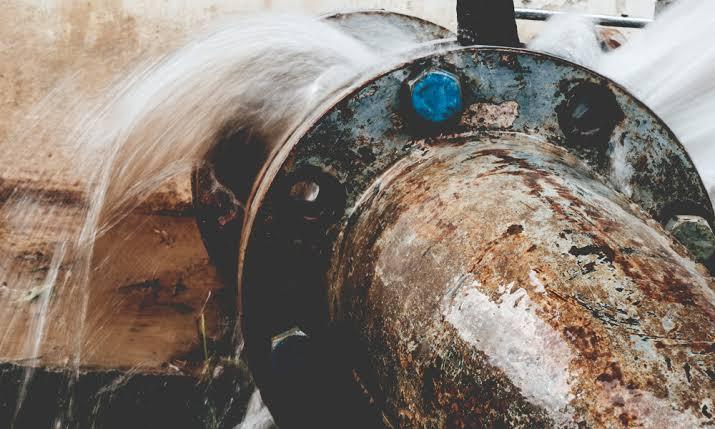
A stainless steel pipe can look clean and shiny, then suddenly leak without a trace of rust. The cause is often stress corrosion cracking (SCC). Stress corrosion cracking is the slow growth of cracks in a metal under the combined action of tensile stress and a specific corrosive environment, ending in brittle fracture of a material that is normally ductile.
Our article on the types of metal corrosion introduces SCC briefly. This guide goes deeper: the conditions it needs, its types by environment, the materials at risk, real-world failures, testing methods, and prevention.
What Is Stress Corrosion Cracking?
Stress corrosion cracking is a form of environmentally assisted cracking in which small cracks start at the metal surface and grow little by little over weeks, months, or years. Once a crack is deep enough, the remaining cross-section can no longer carry the load and the component fails suddenly.
Two things make SCC dangerous. First, very little metal is lost, so ordinary thickness measurements will not find it. Second, the fracture is brittle, even in materials such as austenitic stainless steel or brass that are known for their ductility under normal conditions.
The Three Conditions for SCC
SCC occurs only when three factors are present at the same time:
- A susceptible material. Not every metal is vulnerable to the same environment. Austenitic 300-series stainless steels, brass, high-strength aluminum alloys, and high-strength steels are among the most commonly affected.
- A specific corrosive environment. Each material has its own “partner” environment: chlorides for austenitic stainless steel, ammonia for brass, caustic solutions for carbon steel, and so on. The environment is often only mildly corrosive to the metal, and very small concentrations of the triggering agent can be enough.
- Tensile stress. The stress can come from service loads (internal pressure, structural loads) or from residual stress left by manufacturing, such as welding, cold working, bending, and overtightened bolts. Compressive stress does not cause SCC.
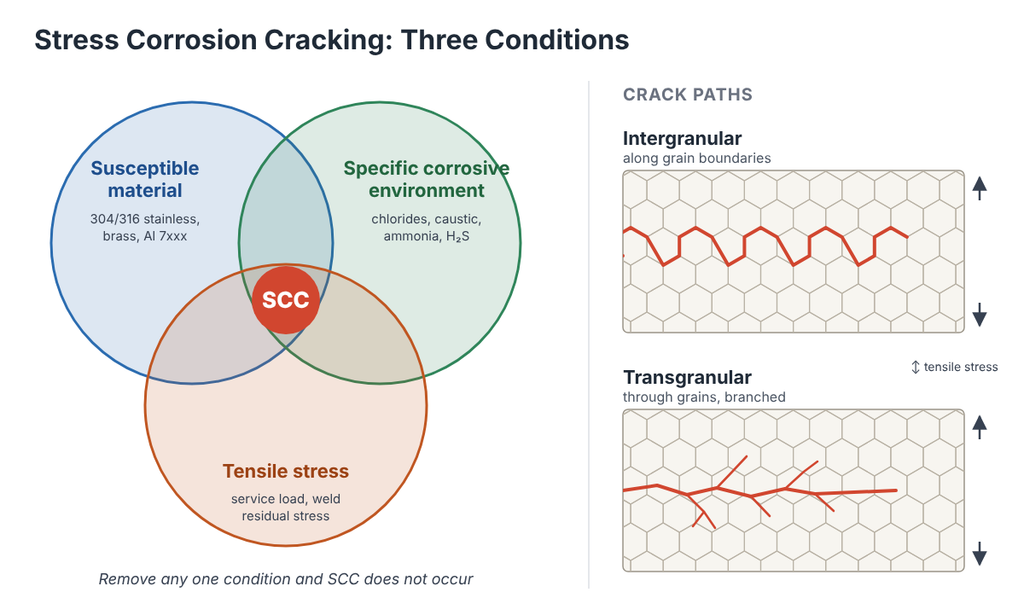
Remove any one of the three, and SCC does not happen. This simple principle is the basis of every prevention method.
Additional Factors: Temperature and Time
Beyond the three main conditions, temperature and time matter a great deal. Most forms of SCC are accelerated by higher temperatures; chloride SCC of austenitic stainless steel, for example, is generally considered a risk above about 60 °C (140 °F). Time matters too, because cracks need an incubation period before they grow, so failures can appear after months or even decades of service.
Characteristics of Stress Corrosion Cracking
SCC has several features that set it apart from ordinary corrosion:
- It happens at low stress. Cracks can grow at stresses well below the material’s yield strength, levels that design calculations treat as safe.
- The surface looks clean. There is little or no rust or thickness loss, so visual inspection is easily fooled.
- Cracks are fine and branched. SCC cracks are usually hairline and branch like tree roots or lightning bolts. They run perpendicular to the tensile stress.
- The fracture is brittle. There is no significant plastic deformation around the fracture, even in a ductile material.
- It often starts at a local defect. Pitting corrosion, scratches, or notches become crack starters because stress concentrates there.
Mechanism: Intergranular and Transgranular Cracking
Metals are made of small crystal grains, and SCC cracks can travel in two ways:
- Intergranular (IGSCC): the crack follows grain boundaries. This is common when the boundaries become weaker or more reactive than the grains themselves, for example in sensitized stainless steel (chromium tied up as carbides at grain boundaries after time in the range of roughly 425 to 815 °C, or 800 to 1,500 °F, usually from welding). Caustic SCC in carbon steel and SCC in brass are also often intergranular.
- Transgranular (TGSCC): the crack cuts through the grains and branches heavily. This pattern is typical of chloride SCC in non-sensitized austenitic stainless steel.
Several mechanisms have been proposed to explain crack growth, including anodic dissolution at the crack tip, repeated rupture of the passive film, and the role of hydrogen entering the metal. The exact mechanism differs for each material and environment pair, and no single theory explains them all. That is why SCC prevention relies more on field experience and testing than on theoretical calculation.
In fracture mechanics, a material’s resistance to SCC is expressed as K<sub>ISCC</sub>, the threshold stress intensity factor. Below this value, an existing crack does not grow in that environment. K<sub>ISCC</sub> can be far lower than the material’s fracture toughness in air.
Types of SCC by Environment
In industry, SCC is usually named after its triggering agent. These are the types you are most likely to meet.
Chloride Stress Corrosion Cracking in Stainless Steel
This is the most widely discussed type of SCC, and it most often attacks austenitic stainless steels such as 304 and 316. Chlorides come from seawater, cooling water, coastal air, condensate, and even sweat residue and cleaning agents.
Temperature. A practical threshold often quoted is about 60 °C (140 °F): below it, chloride SCC of 304 and 316 is uncommon in ordinary water. This limit is not a guarantee. Where chlorides can concentrate, such as on surfaces that repeatedly wet and dry, or in indoor swimming pool atmospheres, cracking can occur at much lower temperatures.
304 versus 316. Grade 316 contains molybdenum, which makes it more resistant to pitting, a frequent crack starter. Its resistance to chloride SCC, however, is not much better than that of 304. Both are considered susceptible in hot chloride environments.
Duplex and other alternatives. Duplex stainless steels (such as 2205) and super duplex grades, with their mixed austenite and ferrite structure, are far more resistant to chloride SCC. Other options include ferritic stainless steels, super-austenitic grades with about 6% molybdenum, and nickel alloys. Nickel content also matters: susceptibility peaks at around 8 to 12% nickel (the range of 304 and 316) and drops sharply at much higher nickel contents.
External chloride SCC. This form attacks the outer surface of stainless steel pipes or vessels under thermal insulation (external chloride stress corrosion cracking, or ECSCC). Rain or condensate soaks into the insulation, picks up chlorides from the insulation or the air, and concentrates them on the hot metal surface.
Caustic Stress Corrosion Cracking (Caustic Embrittlement)
Caustic SCC attacks carbon and low-alloy steels in strong alkaline solutions such as sodium hydroxide (NaOH) or potassium hydroxide. It was once called caustic embrittlement because it often damaged the riveted joints of steam boilers: boiler water containing caustic soda seeped into the joint crevices, evaporated, and left concentrated caustic in highly stressed areas.
The cracks are usually intergranular and are often found near welds that have not been heat treated. The risk rises with caustic concentration and temperature, which is why carbon steel equipment in caustic service is usually given post-weld heat treatment (PWHT) to relieve residual weld stress. Austenitic stainless steels can also suffer caustic SCC, especially at high temperatures.
Ammonia SCC and Season Cracking in Brass
Copper alloys, especially brass, are susceptible to SCC in environments containing ammonia. This is known as season cracking. The name comes from 19th-century brass cartridge cases of the British Army in India that cracked during the monsoon season. High humidity and ammonia from animal waste near the storage areas were enough to crack cases that still held residual stress from cold drawing. The fix at the time was a low-temperature stress-relief anneal, which is still the main way to prevent season cracking today. More about brass alloys can be found in our article on brass casting.
Carbon steel can also suffer SCC in liquid (anhydrous) ammonia, for example in ammonia storage tanks. Oxygen makes the risk worse, while a small amount of water (about 0.2%) has been shown to inhibit cracking. These tanks are usually given post-weld heat treatment as well.
H₂S Cracking: Sulfide Stress Cracking and SOHIC
In the oil and gas industry, environments containing hydrogen sulfide (H₂S) are called sour service. H₂S makes it easier for atomic hydrogen to enter steel, which leads to several forms of cracking:
- Sulfide stress cracking (SSC): cracking of high-strength or high-hardness steels, including weld zones that are too hard, under tensile stress in wet H₂S. Its mechanism is dominated by hydrogen embrittlement, so it is often classified separately from classic SCC even though the symptoms are similar. The main prevention is limiting material hardness, typically to about 22 HRC for carbon and low-alloy steels.
- SOHIC (stress oriented hydrogen induced cracking): arrays of small hydrogen cracks stacked through the thickness, usually near welds with high residual stress.
Material selection for H₂S service in oil and gas follows NACE MR0175/ISO 15156.
Amine, Carbonate, and Polythionic Acid SCC
Several other types are common in refineries and chemical plants:
- Amine SCC: carbon steel that has not been given post-weld heat treatment can crack in amine solutions (used to remove H₂S and CO₂ from gas).
- Carbonate SCC: intergranular cracking of carbon steel in water containing carbonates, for example in refinery fluid catalytic cracking units.
- Polythionic acid SCC: attacks sensitized austenitic stainless steel. Polythionic acids form when sulfide scale meets air and moisture, usually when a refinery unit is shut down for maintenance. Prevention includes low-carbon or stabilized stainless grades and neutralizing equipment with an alkaline solution before it is opened.
Susceptible Materials and Their Triggering Environments
The table below summarizes the best-known material and environment pairs.
| Material | Triggering environment | Notes |
|---|---|---|
| Austenitic stainless steel (304, 316) | Chlorides, especially above about 60 °C (140 °F) | Branched transgranular cracks; duplex is far more resistant |
| Sensitized austenitic stainless steel | Polythionic acids, high-temperature water | Intergranular cracks, often at welds |
| Carbon and low-alloy steel | Caustic solutions (NaOH) | Caustic embrittlement; prevented by PWHT |
| Carbon steel | Anhydrous ammonia, amines, carbonates, nitrates | Highest risk at welds without heat treatment |
| Carbon steel | Fuel-grade ethanol | Found in ethanol storage tanks and pipelines |
| High-strength steel | Wet H₂S, chloride water | SSC; prevented by limiting hardness |
| Brass and copper alloys | Ammonia and ammonia compounds | Season cracking; prevented by stress-relief annealing |
| 2xxx and 7xxx aluminum alloys | Chloride water, humid air | Overaged tempers (such as T73) resist far better than T6 |
| Titanium | Anhydrous methanol, hot chlorides | Small amounts of water inhibit SCC in methanol |
For aluminum alloys, temper choice is critical. Alloy 7075-T6 has the highest strength but is susceptible to SCC, while the T73 temper is slightly weaker but far more resistant. Series and tempers are explained in our article on aluminum alloys, and other forms of aluminum corrosion in our article on aluminum corrosion.
Plain low carbon steel is relatively resistant to chloride SCC, but it remains susceptible in caustic, ammonia, and amine environments, especially at welds.
Stress Corrosion Cracking in Welding
Welded joints are the most common location for SCC because three things happen there at once:
- High residual tensile stress. The weld metal and the surrounding area shrink as they cool and are restrained by the base metal, so residual stress can approach the material’s yield strength.
- Microstructural changes. The heat-affected zone can become harder in steel, or sensitized in austenitic stainless steel.
- Geometry that concentrates stress and corrosive agents. Notches at the weld toe, incomplete penetration, and crevices make it easy for triggering agents to collect.
That is why many construction codes require PWHT for carbon steel equipment in caustic, amine, and ammonia service. For austenitic stainless steel, thermal stress relief is more complicated because the temperature range can cause sensitization. The problem is usually handled by choosing low-carbon grades (304L, 316L) or more resistant grades from the start.
Pipeline Stress Corrosion Cracking
SCC is also found in buried oil and gas pipelines, usually on the outer surface where the coating is damaged or disbonded. There are two main forms:
- High-pH SCC: occurs in concentrated carbonate-bicarbonate solutions that form under the coating, often near compressor stations where temperatures are higher. The cracks are intergranular.
- Near-neutral pH SCC: occurs in dilute groundwater containing dissolved CO₂. The cracks are transgranular and wider because the crack walls also corrode.
In pipelines, cracks usually appear in colonies running parallel to the pipe axis, because the largest stress comes from internal pressure acting around the circumference. Prevention relies on good coatings, controlled cathodic protection, and regular inspection.
Stress Corrosion Cracking Examples
Several major accidents made SCC widely known in engineering.
Silver Bridge, United States (1967). This eyebar chain suspension bridge over the Ohio River collapsed on December 15, 1967, killing 46 people. The NTSB investigation found that one eyebar fractured because a small flaw had grown over about 40 years through the joint action of stress corrosion and corrosion fatigue. The flaw was in a location that could not be inspected without dismantling the joint, and when the bridge was designed, these phenomena were not known to occur in such materials and environments. The disaster led to national bridge inspection standards in the United States.
Uster swimming pool roof, Switzerland (1985). On May 9, 1985, the concrete ceiling of an indoor swimming pool in Uster collapsed, killing 12 people. The ceiling hung from austenitic stainless steel rods without molybdenum that were under tensile stress. The chlorine-containing pool atmosphere caused chloride SCC in the rods, even though the temperature was far below the usual 60 °C (140 °F) threshold. Since then, load-bearing parts in swimming pool atmospheres have been recommended in far more resistant grades, such as 6% molybdenum stainless or super duplex.
Brass cartridge cases (19th century). The season cracking cases in India described above are among the earliest recorded examples of SCC.
How to Detect and Test for SCC
Field Inspection
Because SCC cracks are fine and come with little thickness loss, finding them requires the right non-destructive testing (NDT) methods:
- Penetrant testing (PT): for surface-breaking cracks in stainless steel and non-magnetic metals.
- Wet fluorescent magnetic particle testing (WFMT): for surface cracks in carbon steel; more sensitive than dry particles.
- Ultrasonic testing (UT), including phased array: to size crack depth and find cracks on the inside of pipes or vessels.
- Eddy current testing (ET): widely used for heat exchanger tubes.
Metallographic Examination
To confirm that a crack really is SCC, a section of the component is examined under a microscope. Branching, an intergranular or transgranular path, and corrosion products inside the crack are the clues. This also separates SCC from ordinary fatigue or from manufacturing defects.
Laboratory Tests and ASTM Standards
Susceptibility to SCC is tested by stressing a specimen and exposing it to a test environment. Common standards include:
| Standard | Scope |
|---|---|
| ASTM G30 | U-bend specimens (a strip bent into a U shape) |
| ASTM G38 | C-ring specimens (an open ring stressed with a bolt) |
| ASTM G39 | Bent-beam specimens |
| ASTM G36 | Boiling magnesium chloride (MgCl₂) solution for chloride SCC |
| ASTM G47 | SCC susceptibility of 2xxx and 7xxx aluminum alloys |
| NACE TM0177 | Resistance of metals to SSC and SCC in H₂S environments |
The boiling MgCl₂ test is very aggressive. Materials that perform acceptably in hot chloride service can still crack in it, so the results are used to compare materials rather than to predict service life.
How to Prevent Stress Corrosion Cracking
Because SCC needs all three factors, prevention means removing or reducing at least one of them.
1. Choose a Material That Is Not Susceptible
This is the most reliable approach, especially when decided at the design stage. Examples include using duplex or super duplex instead of 304/316 in hot chloride service, using the T73 temper for 7xxx aluminum, or using hardness-limited steels for H₂S service. General guidance on choosing materials is in our article on material selection for metal casting.
2. Remove Residual Stress
Residual stress from welding and cold work can be reduced by stress-relief heat treatment. For carbon steel, PWHT is typically carried out at about 595 to 650 °C (1,100 to 1,200 °F). For brass, stress-relief annealing uses much lower temperatures, roughly 250 to 300 °C (480 to 570 °F). The process is explained further in our article on annealing.
3. Put the Surface in Compression
Shot peening fires small steel balls at the surface in a controlled way, creating a thin layer under compressive stress. Since SCC needs tensile stress, this layer makes cracks much harder to start. The process resembles shot blasting, but the goal is different: shot blasting cleans the surface, while shot peening changes the surface stress under tightly controlled parameters. Burnishing and laser peening work on the same principle.
4. Control the Environment
- Lower the operating temperature where possible.
- Limit chlorides, oxygen, or other triggering agents in process and cooling water.
- Keep triggering agents from concentrating, for example by avoiding wet-dry cycles and keeping insulation dry.
- Add corrosion inhibitors, or add a small amount of water to anhydrous ammonia and methanol.
5. Coatings and Cathodic Protection
Coatings separate the metal from the triggering environment. Cathodic protection can help, for example on buried pipelines. On high-strength steels, however, excessive cathodic protection generates hydrogen at the metal surface and can cause hydrogen embrittlement, so the protection level must be controlled. These methods are summarized in our guide on how to prevent corrosion in metals.
6. Design and Inspection
Avoid sharp notches, crevices, and joints that can trap corrosive agents. For equipment already in service, schedule regular NDT at the highest-risk locations, especially welds and hot areas.
Can Stress Corrosion Cracking Be Repaired?
SCC cracks cannot be repaired simply by welding over them. The cracks are branched and can run much deeper than they appear, and welding without removing the whole crack leaves crack tips under the new weld. A repair weld also adds new residual stress in the same spot.
A proper repair usually involves removing the entire crack by grinding or machining and confirming it is gone with penetrant or magnetic particle testing, rewelding with a suitable procedure, and applying post-weld heat treatment where the material allows. The general principles are covered in our article on repair welding. If cracking is extensive, replacing the component is often safer. Most importantly, the cause must be fixed. Without that, SCC will return in the same place.
SCC vs. Hydrogen Embrittlement vs. Corrosion Fatigue
These three forms of damage are often confused because all of them produce environmentally assisted cracks.
| Aspect | Stress corrosion cracking | Hydrogen embrittlement | Corrosion fatigue |
|---|---|---|---|
| Type of load | Static or sustained tensile stress | Static tensile stress | Repeated (cyclic) stress |
| Environment | Specific to each material | A hydrogen source (H₂S, cathodic protection, electroplating, welding) | Almost any corrosive environment |
| Most susceptible materials | Austenitic stainless, brass, high-strength aluminum | High-strength, high-hardness steels | Almost all metals |
| Crack appearance | Fine and branched | Usually intergranular, little branching | Straight, rarely branched, often in colonies |
| Main prevention | Change material, remove residual stress | Limit hardness, reduce hydrogen sources | Reduce cyclic stress, coat the surface |
In practice, these mechanisms can act together, as at the Silver Bridge, where the crack grew through the joint action of stress corrosion and corrosion fatigue.
Frequently Asked Questions
What is stress corrosion cracking? Stress corrosion cracking is cracking in a metal that grows under the combined action of tensile stress and a specific corrosive environment. It can cause sudden brittle fracture in a normally ductile material, even when the surface shows almost no rust.
What causes stress corrosion cracking? SCC needs three factors at once: a susceptible material, a corrosive environment specific to that material, and tensile stress from service loads or residual stress. High temperature and long service time speed it up.
At what temperature does chloride stress corrosion cracking occur in stainless steel? A practical threshold often used for 304 and 316 stainless steel is about 60 °C (140 °F). Where chlorides can concentrate, however, such as in indoor swimming pool atmospheres or on surfaces that repeatedly wet and dry, SCC can occur at lower temperatures.
Is 316 stainless steel resistant to stress corrosion cracking? Not fully. Grade 316 resists pitting better than 304, but its resistance to chloride SCC is not much different. For hot chloride environments, duplex, super duplex, or nickel alloys are safer choices.
How do you prevent stress corrosion cracking? Remove at least one of its three conditions: choose a non-susceptible material, relieve residual stress with heat treatment, put the surface in compression with shot peening, or control the environment (temperature, chloride levels, inhibitors). Regular inspection is still needed for equipment at risk.


