
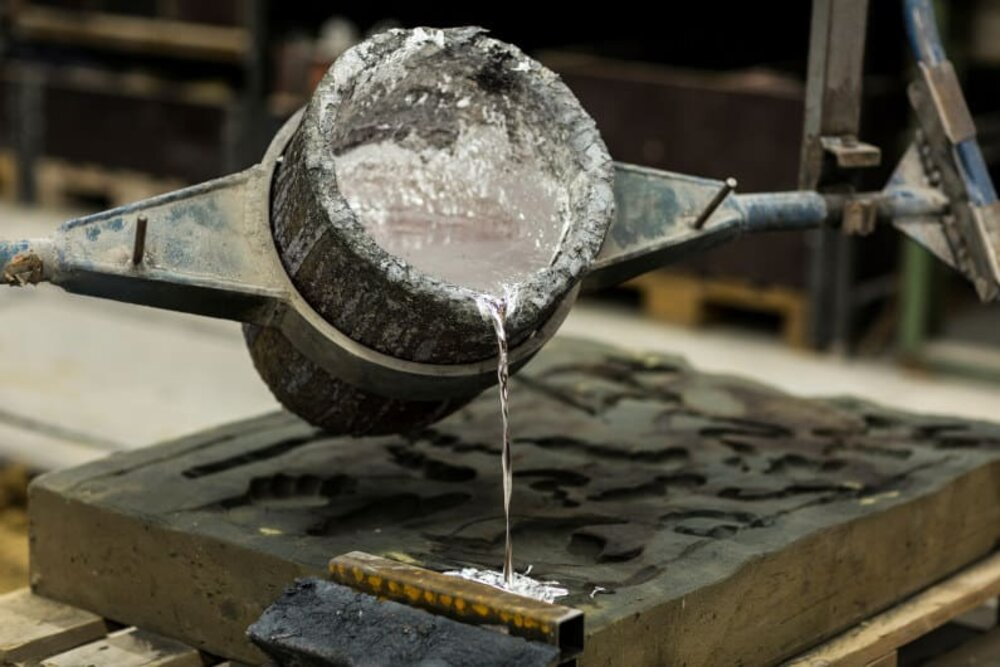
Car wheels, motorcycle engine blocks, gearbox housings, and cookware are often made by aluminum casting. Aluminum casting is the process of shaping a part by pouring molten aluminum into a mold and letting it solidify in the shape of the mold cavity. The process looks simple, but molten aluminum has two habits that ruin many castings: it picks up hydrogen easily, and it forms an oxide skin almost instantly. This guide covers the casting methods, the common alloys, each step of the process, and the defects that show up most often, with ways to prevent them.
Why Aluminum Is Cast So Widely
Aluminum is the most widely cast non-ferrous metal. The reasons:
- Low melting point. Pure aluminum melts at 660 °C (1220 °F), far below cast iron (about 1150–1200 °C, 2100–2190 °F) and steel (about 1500 °C, 2730 °F). Melting takes less energy, and metal molds can be reused many times.
- Good fluidity. Aluminum-silicon alloys fill thin sections easily. The factors behind this are covered in our article on the fluidity of molten metal.
- Low weight. Its density is about 2.7 g/cm³, roughly one third that of steel.
- Natural corrosion resistance from a thin oxide film. Its limits are explained in our article on aluminum corrosion.
- Easy recycling. Casting scrap can be remelted using a small fraction of the energy needed to make new aluminum.
The trade-off is lower strength and wear resistance than cast iron or cast steel. The three are compared in our guide to choosing materials for metal casting.
Aluminum Casting Methods
Aluminum can be cast by almost every casting method. The choice depends on production volume, part size, wall thickness, and the surface quality required.
| Method | Mold | Production volume | Minimum wall | Typical parts |
|---|---|---|---|---|
| Sand casting | Silica sand and binder, single use | One-offs to thousands | About 4 mm (0.16 in) | Pump housings, large engine blocks, prototypes |
| Permanent mold (gravity) | Steel or cast iron, reusable | Thousands to tens of thousands | About 3 mm (0.12 in) | Pistons, cylinder heads |
| Low-pressure die casting (LPDC) | Metal mold filled from below with low air pressure | Medium to high | About 3 mm (0.12 in) | Car wheels |
| High-pressure die casting (HPDC) | Steel die, metal injected at high speed | Tens of thousands and up | 1–2 mm (0.04–0.08 in) | Gearbox housings, electronics enclosures, brackets |
| Investment casting | Ceramic shell from a wax pattern | Low to medium | About 1.5–2 mm (0.06–0.08 in) | Precision parts, impellers |
| Lost foam | Foam pattern in unbonded sand | Medium to high | About 3 mm (0.12 in) | Engine blocks, cylinder heads |
Sand casting is the cheapest way to start, because patterns can be made of wood and the mold needs no hardening. The parts of a sand mold and how it is made are covered in our article on the sand mold. The surface is rougher and dimensional accuracy is lower than with metal molds.
Aluminum die casting under high pressure is the most productive method. A cycle takes only tens of seconds, and walls can be as thin as 1–2 mm. The drawback is that metal injected this fast traps air. The trapped air expands when the casting is heated, so conventional die castings are generally not given a T6 heat treatment and are not welded.
The three main methods are compared in detail in sand casting vs die casting vs investment casting, and lost foam is covered in other metal casting methods.
Aluminum Casting Alloys
Casting alloys are different from the alloys used for sheet, extrusions, and bar. Casting alloys use the Aluminum Association’s three-digit designation (for example 356.0 or A356), while wrought alloys use four digits (1xxx to 8xxx). The wrought series are covered in our guide to aluminum alloys.
| Alloy | Main alloying elements | Common methods | Characteristics | Typical uses |
|---|---|---|---|---|
| A356 (AlSi7Mg) | Si 6.5–7.5%, Mg 0.25–0.45% | Sand, permanent mold, LPDC | Heat treatable to T6, ductile and strong | Wheels, suspension parts |
| A380 | Si 7.5–9.5%, Cu 3–4% | HPDC | Excellent castability, good strength at temperature | Housings, gearbox cases |
| ADC12 | Si 9.6–12%, Cu 1.5–3.5% | HPDC | Japanese JIS grade, the most common die casting alloy in Asia | Motorcycle parts, enclosures |
| 319 | Si 5.5–6.5%, Cu 3–4% | Sand, permanent mold | Good strength at high temperature, machines well | Cylinder heads, engine blocks |
| A413 | Si 11–13% | HPDC | Eutectic composition, highest fluidity, pressure tight | Thin-walled parts, hydraulic components |
| AlSi10Mg | Si 9–11%, Mg 0.2–0.45% | Permanent mold, HPDC, 3D printing | Heat treatable to T6 | Automotive parts, additive manufacturing |
| 535 (Al-Mg) | Mg 6.2–7.5% | Sand, investment | Resists seawater corrosion, harder to cast | Marine hardware |
Each alloying element has its own job:
- Silicon raises fluidity and reduces shrinkage, which is why nearly all casting alloys are Al-Si alloys.
- Copper adds strength, especially at high temperature, but lowers corrosion resistance.
- Magnesium allows precipitation hardening through T6 heat treatment.
- Iron is usually treated as an impurity because it forms brittle needle-shaped crystals. In die casting, however, about 0.8–1% iron is kept on purpose to stop aluminum from sticking to the die.
A380 is the workhorse of aluminum die casting in North America, and ADC12 fills the same role in Asia. Both are high in copper, which suits thin, complex parts but rules out T6. Parts that need ductility and strength after heat treatment, such as wheels, use A356.
The Aluminum Casting Process, Step by Step
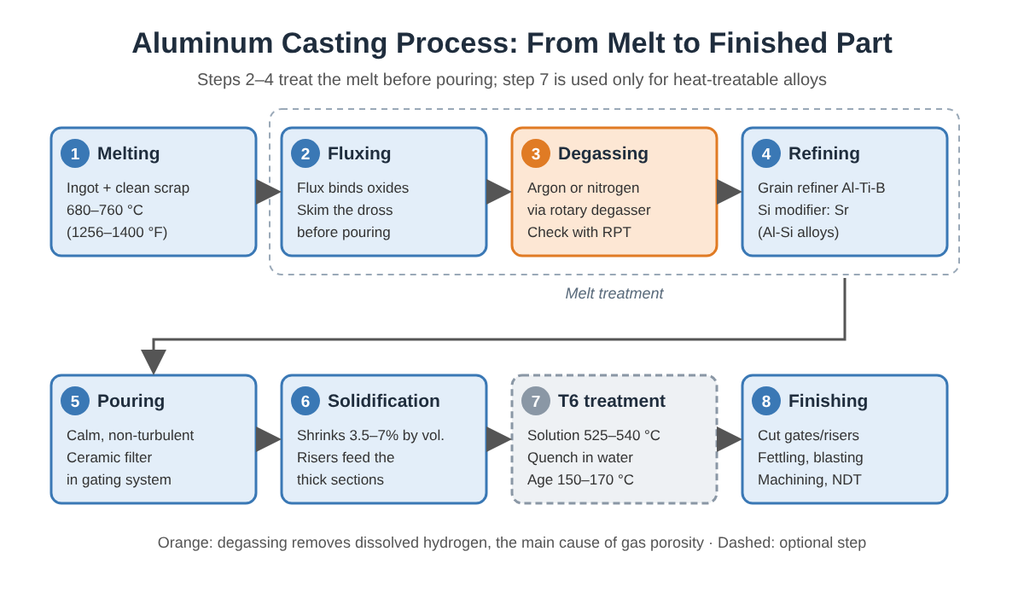
The aluminum casting process has eight steps. Steps 2 to 4 treat the molten metal before pouring, and they decide most of the casting’s quality.
1. Melting
Aluminum is melted in a crucible furnace for small to medium work, an induction furnace, or a reverberatory furnace for large volumes. The pros and cons of each are covered in our guide to melting furnaces for metal casting.
Pouring temperature is usually 680–760 °C (1256–1400 °F), depending on the method and wall thickness. Sand molds and thin sections need the upper end; die casting usually runs cooler. Avoid heating the metal far beyond what is needed (above about 780 °C, 1436 °F), because hydrogen pickup and oxide formation rise sharply. Ingot and scrap must be dry and should be preheated before going into the melt.
2. Fluxing and Drossing
Molten aluminum is covered by oxide almost immediately. A powdered flux is spread and gently stirred in so that oxides and dirt collect into floating dross, which is skimmed off before pouring. Oxide left behind ends up as inclusions in the casting, as described in our article on inclusion and contamination defects.
3. Degassing
Hydrogen is the only gas that dissolves in significant amounts in molten aluminum. It comes from moisture: humid air, wet charge material, tools that were not preheated, or flux that has absorbed water. Solid aluminum holds about twenty times less hydrogen than liquid aluminum, so as the metal freezes the hydrogen comes out of solution and forms bubbles that are trapped as gas porosity.
Degassing blows argon or nitrogen into the melt through a spinning impeller (a rotary degasser), usually for 5–15 minutes. The inert gas bubbles collect hydrogen and carry it to the surface. The result is checked with a reduced pressure test (RPT): a sample solidifies under vacuum and is then sectioned or weighed to show how much porosity remains.
4. Grain Refining and Silicon Modification
Two additions are often made before pouring:
- Grain refiner, in the form of Al-5Ti-1B master alloy rod. Finer grains reduce the risk of hot tearing and spread any porosity more evenly.
- Strontium modifier (about 0.01–0.02% Sr) for Al-Si alloys. Strontium changes the eutectic silicon from brittle needles into a fine fibrous form, which improves ductility.
5. Pouring
Molten aluminum must flow calmly. Turbulent flow folds the surface oxide skin into the metal, forming oxide films that start cracks and cause leaks. The gating system is designed to keep metal velocity low at the ingates, and ceramic filters are placed in the runner to catch dross. The design principles are covered in our article on gating and riser system design.
6. Solidification
Aluminum shrinks about 3.5–7% by volume as it solidifies, depending on the alloy; high-silicon alloys shrink the least. Thick sections freeze last and need a riser to feed them so they do not form cavities. How to size one is shown in how to calculate riser size. Chills (metal blocks set in a sand mold) are used to speed up freezing in selected areas.
7. Heat Treatment
Alloys that contain magnesium, such as A356 and AlSi10Mg, can be strengthened with the T6 treatment:
- Solution treatment at 525–540 °C (977–1004 °F) for 4–12 hours, so magnesium and silicon dissolve evenly.
- Quench into water (usually warm water to limit distortion).
- Artificial aging at 150–170 °C (302–338 °F) for several hours, forming fine precipitates that block dislocation movement.
A lighter option is T5, which is aging only, without solution treatment. The basics of heat treatment are covered in our guide to metal heat treatment.
8. Finishing and Inspection
Gates and risers are cut off, flash is ground away, the surface is cleaned by shot blasting, and functional surfaces are machined. The details are in our article on finishing metal castings. Critical parts are inspected with radiography or leak testing to find internal porosity.
Common Aluminum Casting Defects and How to Prevent Them
| Defect | Appearance | Main cause | Prevention |
|---|---|---|---|
| Gas porosity | Small round holes with smooth walls | Hydrogen from moisture | Degassing, dry charge and tools, no overheating |
| Shrinkage porosity | Jagged cavities in thick sections | Not enough liquid feed during freezing | Risers and chills, uniform wall thickness |
| Oxide films and inclusions | Fine cracks, leaks under pressure testing | Turbulent pouring, dross carried in | Flux, ceramic filters, calm pouring |
| Hot tearing | Ragged cracks at corners or section changes | Stress while the metal is partly solid, especially Al-Cu alloys | Corner radii, grain refiner, less rigid molds |
| Cold shut and misrun | Flow fronts that did not fuse, or an unfilled cavity | Pouring temperature too low, walls too thin | Raise pouring temperature, improve gating |
| Blistering | Surface bubbles after the casting is heated | Air trapped during die casting | Vacuum die casting, avoid T6 for conventional die castings |
| Die soldering | Aluminum stuck to the die surface | Low iron content, die too hot | About 0.8% Fe, die lubricant, die temperature control |
Porosity is the most common complaint. To tell gas porosity from shrinkage, look at the cavity walls: gas holes are round and smooth, while shrinkage cavities are jagged and follow the shape of the dendrites. For more depth, see our articles on porosity and hot tearing, cold shut and misrun defects, and the full list of types of casting defects.
Small-Scale Aluminum Casting: Safety Notes
Aluminum casting is widely practiced in small shops, technical schools, and by hobbyists, usually with a crucible furnace and sand molds. Keep these points in mind:
- Water is the biggest hazard. Water that touches molten aluminum turns into steam with about 1,600 times its volume in an instant and can throw molten metal. Dry and preheat scrap, stirring rods, ladles, and molds.
- Do not pour over concrete. Concrete holds moisture and can burst when molten metal drips on it. Work over a bed of dry sand.
- Choose good feedstock. Beverage cans make a lot of dross because they are thin and coated. Cast scrap such as old wheels or pistons, or ingot, gives far better results.
- Wear protective gear: closed leather boots, cotton clothing (synthetics melt), a face shield, and heat-resistant gloves.
- Ventilate well, because flux and coatings on scrap produce fumes.
FAQ
What are the melting and pouring temperatures of aluminum? Pure aluminum melts at 660 °C (1220 °F). Casting alloys start to melt slightly lower, and pouring temperature is usually 680–760 °C (1256–1400 °F), depending on the method and wall thickness.
What is the difference between A356 and A380? A380 is high in silicon and copper, is used for high-pressure die casting, and is generally not heat treated. A356 contains silicon and a little magnesium, is cast in sand or permanent molds, and can be strengthened by T6 heat treatment.
Why does my aluminum casting have holes? The most common cause is hydrogen from moisture coming out of solution as the metal freezes. Dry the charge and tools, degas the melt, and do not overheat it. If the cavities are jagged and gathered in thick sections, the cause is shrinkage, and the fix is better feeding with risers.
Can aluminum die castings be welded or heat treated to T6? Generally not, because trapped air expands when heated and forms surface blisters. Vacuum die casting or squeeze casting produces denser castings that can be heat treated.
What mold is best for small-scale aluminum casting? A sand mold, because the pattern can be made of wood and the cost is lowest. For repeated production of the same shape, a permanent mold of steel or cast iron is more efficient.


