Manganese steel, more fully austenitic high-manganese steel, is a steel containing about 11–14% manganese and 1–1.3% carbon. It is also known as Hadfield steel or mangalloy. Its behavior is unusual: as made, its hardness is only about 200 HB, no harder than ordinary stainless steel. Once its surface is struck repeatedly, for example by rock inside a crusher, that surface hardens itself to about 450–550 HB, while the interior stays tough.
That combination of a surface that keeps getting harder and an extremely tough core makes manganese steel the standard material for crusher jaws, excavator bucket teeth, and railway crossings. Almost all manganese steel parts are cast. This guide covers its composition and grades, heat treatment, how work hardening works, casting, welding, applications, and when manganese steel is the wrong choice.
What Is Manganese Steel?
The term “manganese steel” can be confusing, because nearly all steels contain manganese. Two things need separating:
- Ordinary carbon steels contain about 0.3–1.65% manganese. At these levels manganese ties up oxygen and sulfur (forming MnS) and adds hardenability. Steels such as A36 and 1045 belong here. They are not called manganese steel.
- High-manganese steel contains about 11–14% manganese. At this level, manganese keeps the austenite structure stable at room temperature. This is the manganese steel this article is about.
Because it is austenitic, high-manganese steel is non-magnetic, even though it is more than 80% iron. That is a quick way to tell it apart from other wear-resistant steels in the field.
A short history of Hadfield steel
Manganese steel was discovered by the British metallurgist Robert Hadfield in 1882 and patented in 1883. At the time, metallurgists believed that more than about 1.5% manganese made steel brittle. Hadfield found that at around 12% manganese, after quenching from a high temperature, the steel became very ductile and hardened as it was deformed. It was one of the first alloy steels produced commercially and is still widely used today.
Composition and Grades of Manganese Steel
The manganese-to-carbon ratio
Standard Hadfield steel contains about 12–13% manganese and 1.0–1.3% carbon, a Mn:C ratio of roughly 10:1. The two depend on each other:
- Carbon raises yield strength and the work-hardening rate, so wear resistance improves. But too much carbon is hard to dissolve fully during heat treatment, and leftover carbides make the steel brittle.
- Manganese stabilizes austenite. If manganese is too low relative to carbon, the austenite can transform to martensite or precipitate carbides.
ASTM A128 grades
The standard most often used for manganese steel castings is ASTM A128. Silicon is limited to 1.00% and phosphorus to 0.07% for all grades.
| Grade | Carbon (%) | Manganese (%) | Added alloy | Notes |
|---|---|---|---|---|
| A | 1.05–1.35 | 11.0 min. | — | General grade |
| B-1 | 0.90–1.05 | 11.5–14.0 | — | Lower carbon, more ductile |
| B-2 | 1.05–1.20 | 11.5–14.0 | — | Most widely used |
| B-3 | 1.12–1.28 | 11.5–14.0 | — | |
| B-4 | 1.20–1.35 | 11.5–14.0 | — | Higher carbon, more wear-resistant |
| C | 1.05–1.35 | 11.5–14.0 | Cr 1.5–2.5 | Higher yield strength |
| D | 0.70–1.30 | 11.5–14.0 | Ni 3.0–4.0 | More stable austenite, easier to weld |
| E-1 | 0.70–1.30 | 11.5–14.0 | Mo 0.9–1.2 | For heavy sections |
| E-2 | 1.05–1.45 | 11.5–14.0 | Mo 1.8–2.1 | For heavy sections |
| F | 1.05–1.35 | 6.0–8.0 | Mo 0.9–1.2 | Medium-manganese steel |
Equivalents in other standards
- DIN/EN: X120Mn12 (1.3401) for wrought steel, GX120Mn13 (1.3802) for cast steel
- China: ZGMn13 for cast steel, often sold as “Mn13”
- France: Z120M12
Other manganese steel variants
- 18% and 21–22% manganese steels: more manganese makes the austenite more stable and raises the work-hardening rate. Used for crusher liners under very heavy loads.
- Mn-Cr (Grade C): chromium raises yield strength, so the surface is less prone to “flowing” (spreading) under load.
- Mn-Mo (Grade E): molybdenum helps suppress carbide precipitation in heavy sections.
- Medium-manganese steel (about 6% Mn, Grade F): cheaper and suited to moderate impact, but less tough.
Microstructure and Heat Treatment
The carbide problem in the as-cast condition
As cast and cooled slowly in the mold, manganese steel contains carbides at the grain boundaries. In this condition it is very brittle and can break in service. That is why almost every manganese steel casting must be heat treated.
Solution annealing and water quenching
The standard heat treatment for manganese steel is solution annealing, sometimes called “water toughening”:
- The casting is heated slowly and evenly to about 1,000–1,100 °C (1,830–2,010 °F). Heating must be slow, because manganese steel has low thermal conductivity and heating too fast can crack the casting.
- It is held at temperature until all carbides dissolve into the austenite. The time depends on section thickness.
- It is quenched in water as fast as possible. The transfer from furnace to tank must be quick, because slow cooling lets carbides precipitate again.
The result is a single-phase austenite structure that is ductile, with a hardness of about 190–230 HB. Unlike carbon steel, quenching manganese steel softens and toughens it rather than hardening it. No tempering is needed. Other heat treatment principles are covered in our article on types of heat treatment.
Do not reheat above about 300 °C
After solution annealing, manganese steel should not be held for long above about 300 °C (570 °F). At these temperatures carbides start to precipitate at the grain boundaries again and the steel becomes brittle. This limit matters for welding, flame cutting, and service in hot environments.
Work Hardening: Why Manganese Steel Gets Harder Under Impact
Work hardening is manganese steel’s most important property. When its surface takes impact or high pressure, a thin surface layer deforms plastically. Inside the austenite grains, deformation twins form and the dislocation density rises sharply. Both obstruct further dislocation movement, so the surface gets harder.
As a result, a surface that starts at about 200 HB can reach 450–550 HB after a period in service. The hardened layer is typically a few millimeters deep, and it keeps re-forming as the surface wears away. Beneath it, the austenitic core stays ductile and absorbs impact without cracking.
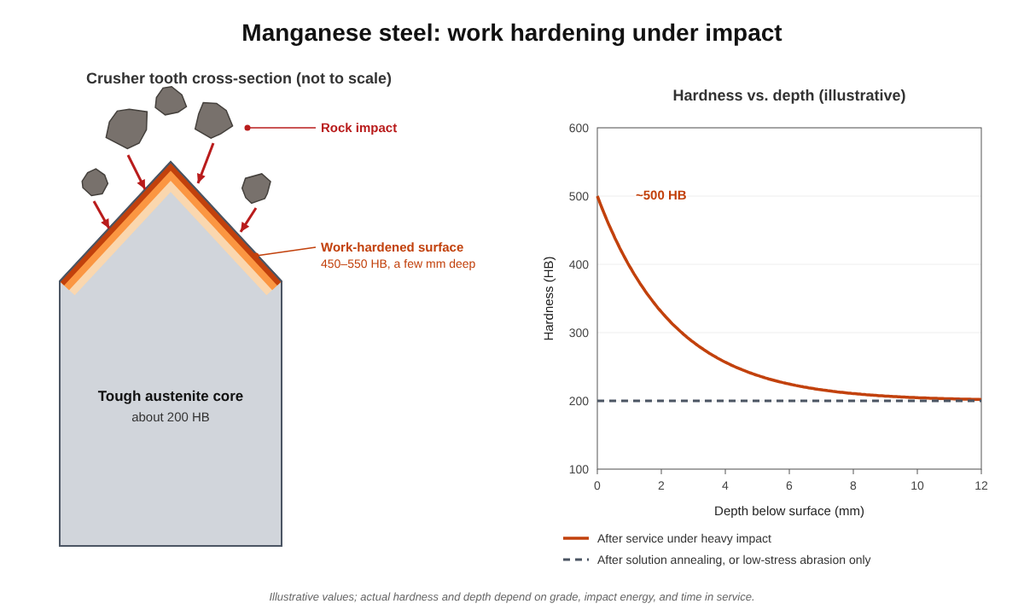
The diagram above shows the surface layer that hardens under rock impact and its hardness profile. The values are illustrative: from about 200 HB after solution annealing to about 500 HB at the surface after service, falling back to the original hardness a few millimeters down.
When work hardening happens, and when it doesn’t
Work hardening only happens when the stress at the surface is high enough to deform the steel plastically. That decides whether manganese steel is a good fit:
- Good fit: heavy impact and high-stress abrasion, such as large rock being crushed, bucket teeth striking rocky ground, or train wheels pounding a crossing.
- Poor fit: low-stress abrasion without impact, such as fine sand sliding down a chute or slurry in a pump. The surface never hardens, so the steel wears quickly at its starting hardness of about 200 HB.
On parts that need to be hard from day one, such as railway crossings, the surface can be pre-hardened by explosive hardening or peening.
Mechanical and Physical Properties
| Property | Value (approx., after solution annealing) |
|---|---|
| Initial hardness | 190–230 HB |
| Hardness after work hardening | 450–550 HB (surface) |
| Tensile strength | 750–1,000 MPa (109–145 ksi) |
| Yield strength | 350–450 MPa (51–65 ksi) |
| Elongation | 30–60% |
| Magnetic behavior | Non-magnetic |
| Low-temperature toughness | Stays tough well below 0 °C (32 °F) |
| Density | About 7.9 g/cm³ |
These are general ranges for grades such as B-2 and depend on composition, section thickness, and heat treatment quality. What stands out is the combination of high tensile strength with very large elongation. Yield strength is relatively low, so a manganese steel surface can “flow” or spread under heavy load before it hardens.
Casting Manganese Steel
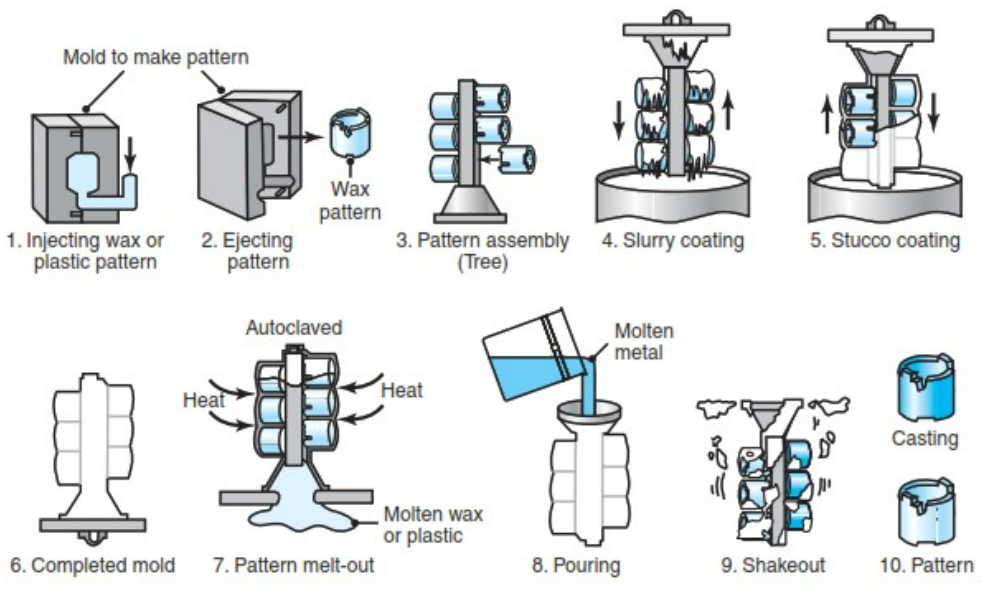
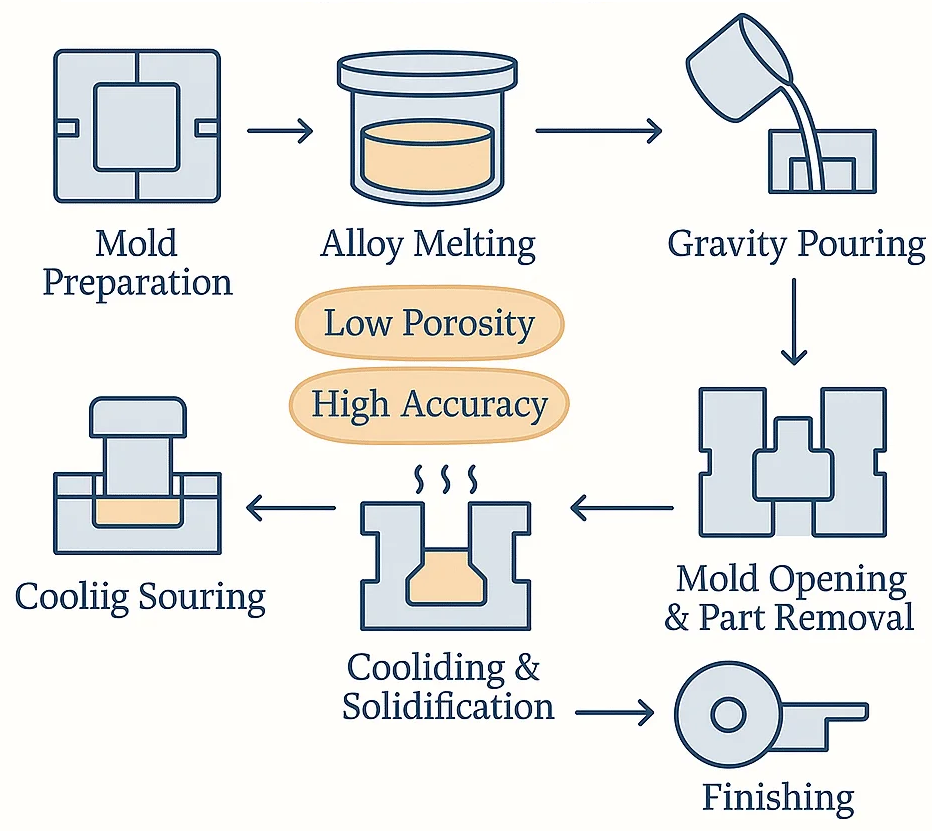
Almost all manganese steel parts are sand cast, because the steel is so hard to machine and form. A few things set it apart from casting carbon steel:
- Melting: usually in induction or electric arc furnaces. Manganese oxidizes easily, so ferromanganese is added late in the melt. Furnace types are covered in our article on melting furnaces.
- Relatively low pouring temperature: manganese steel is poured not far above its liquidus to get a fine grain. Coarse grain lowers toughness.
- High shrinkage: pattern shrinkage is about 2.5–3%, more than carbon steel. Risers must be large and well placed. See gating and riser system design and how to calculate riser size.
- Prone to hot tearing: low thermal conductivity and high shrinkage make castings crack easily at corners and section changes. Generous radii and a mold that is not too rigid help. The mechanism is covered in our article on porosity and hot tearing.
- Riser removal: risers are usually removed by air carbon arc gouging or plasma, then ground. Cutting heat must be controlled so carbides do not precipitate near the cut. Casting cleanup is covered in our article on fettling.
- Heat treatment: solution annealing and water quenching, done after the risers are removed.
The steel casting process in general is covered in our guide to steel casting.
Machining, Welding, and Hardfacing
Machining manganese steel
Manganese steel is notoriously hard to machine. As soon as the tool touches the surface, the steel hardens right ahead of the cutting edge. Machining is still possible with carbide or CBN tools, low cutting speeds, a heavy enough feed that the tool always cuts beneath the hardened layer, and a rigid machine. In practice, most finishing is done by grinding, and holes are cast in.
Welding manganese steel
Manganese steel can be welded, but the rules are the opposite of carbon steel:
- Do not preheat. Keep the base metal cool instead.
- Limit interpass temperature to below about 260 °C (500 °F); many shops set a lower limit. Excess heat precipitates carbides in the heat-affected zone.
- Use low heat input: short beads, skip welding, and cooling between passes.
- Use austenitic consumables: manganese steel electrodes for filling or rebuilding manganese steel, or austenitic stainless electrodes (such as type 309) for joining manganese steel to carbon steel.
- Peening after each pass can reduce tensile stress.
General repair techniques for castings are covered in our article on repair welding of metal castings.
Hardfacing
Worn manganese steel parts are often rebuilt by welding and then given a hardfacing layer of chromium carbide alloy on the areas that wear most. The hard overlay is backed by the tough manganese steel core. The buildup layer should still be manganese steel or austenitic stainless, because hardfacing applied directly onto manganese steel is prone to cracking and spalling.
Applications of Manganese Steel
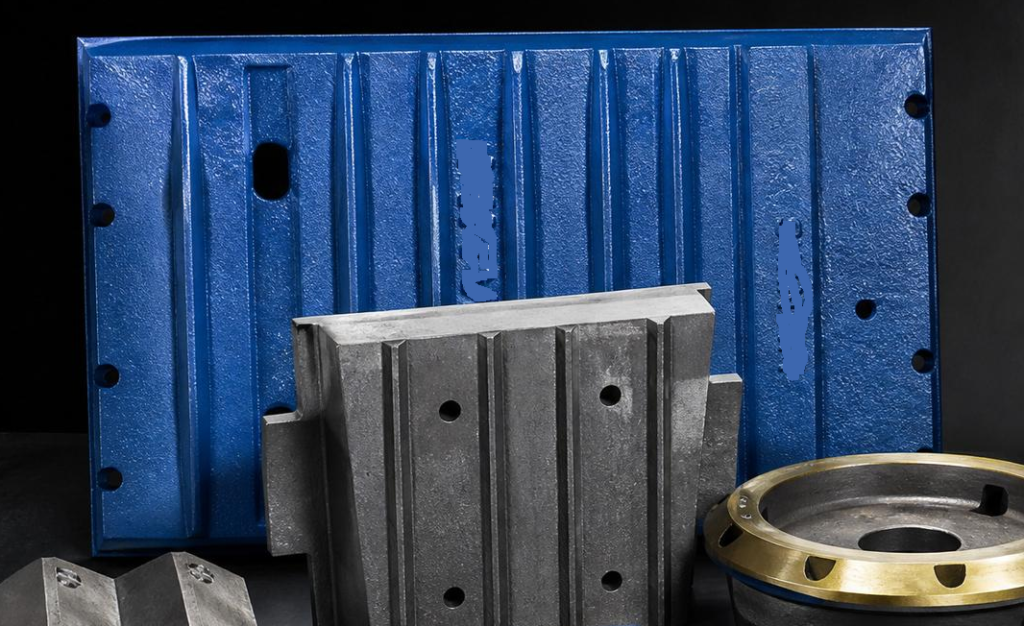
- Rock crushers: jaw plates for jaw crushers, mantles and concaves for cone crushers, hammers and blow bars for impact crushers.
- Mining and construction: excavator bucket teeth and lips, dragline bucket liners, ball mill liners.
- Railways: switches and crossings (frogs) that take constant wheel impact.
- Heavy equipment: track shoes, pins, and bushings for crawler tracks.
- Shot blasting machines: cabinet liners and blast wheel blades struck by steel shot. The process is covered in our article on shot blasting.
- Security: safe plates and anti-cut bars, because manganese steel is hard to drill and saw.
- Electromagnet covers and other parts that must be non-magnetic.
- Cryogenic uses: high-manganese steel stays tough at very low temperatures, so it is being developed for liquefied natural gas tanks.
Manganese steel vs. other “wear plate”
In some markets, “manganese plate” or “wear plate” is used loosely for other abrasion-resistant plates (quenched and tempered grades around 400–500 HB) with very different properties. Ask for a mill certificate with the chemical composition, or try a magnet: high-manganese steel is not attracted, while quenched and tempered wear plate is.
When Manganese Steel Is Not the Best Choice
| Aspect | Manganese steel (Hadfield) | High-chromium white iron | Abrasion-resistant (AR) steel plate |
|---|---|---|---|
| Structure | Austenite | Chromium carbides in martensite | Quenched and tempered martensite |
| Initial hardness | 190–230 HB | 600–700 HB | 400–500 HB |
| Hardness in service | 450–550 HB (after impact) | Unchanged | Unchanged |
| Impact toughness | Very high | Low, brittle | Medium |
| Low-stress abrasion resistance | Low | Very high | High |
| Product form | Mainly castings | Castings | Plate |
| Weldability | Difficult, special rules | Practically unweldable | Good |
| Typical uses | Crusher jaws, bucket teeth, rail crossings | Slurry pump liners, mill liners, sand chutes | Dump truck bodies, chutes, bucket liners |
The choice depends on the type of wear:
- Heavy impact and large rock: manganese steel.
- Sliding abrasion without much impact, such as sand, slurry, and fine ore: high-chromium white cast iron or Ni-hard.
- Moderate abrasion with some impact on plate parts that must be welded and formed: AR steel plate.
For general guidance on choosing casting materials, see our article on material selection for metal casting.
Common Problems with Manganese Steel
- Brittleness from carbides: incomplete heat treatment, a delayed quench, or a part that has been heated above about 300 °C (570 °F), for example during welding or flame cutting.
- Hot tearing in castings, especially at sharp corners and section changes.
- Coarse grain from too high a pouring temperature, lowering toughness.
- Rapid wear when used for low-stress abrasion without impact, so the surface never hardens.
- Surface flow on parts loaded heavily before they harden. Sometimes the surface spreads so much that parts such as crusher liners become hard to remove.
- Weld cracking from high heat input or the wrong consumable.
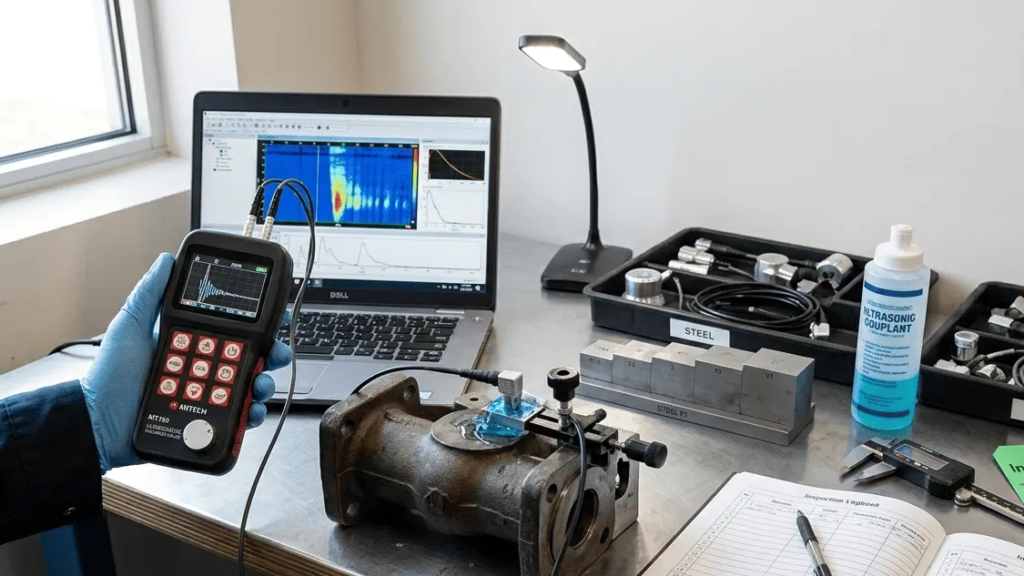
Surface cracks in manganese steel castings can be found with non-destructive testing (NDT). Because manganese steel is non-magnetic, magnetic particle testing cannot be used. Dye penetrant or ultrasonic testing is used instead.
Frequently Asked Questions
What is manganese steel? Manganese steel is an austenitic steel with about 11–14% manganese and 1–1.3% carbon, also known as Hadfield steel or mangalloy. It starts at about 200 HB, but its surface hardens to 450–550 HB under impact while the core stays tough.
Why does manganese steel get harder in use? Impact and high pressure deform the austenitic surface plastically. Deformation twins and large numbers of dislocations form inside the grains and block further deformation, so the surface hardens. This is called work hardening.
Can manganese steel be hardened by quenching? No. Quenching manganese steel softens and toughens it, because the aim is to dissolve carbides and keep the austenite. Manganese steel only gets harder through surface deformation, not heat treatment.
Can manganese steel be welded? Yes, with manganese steel or austenitic stainless electrodes, no preheat, low heat input, and an interpass temperature below about 260 °C (500 °F). Excess heat precipitates carbides and makes the steel brittle.
Is manganese steel magnetic? No. High-manganese steel is austenitic and therefore non-magnetic, while quenched and tempered wear plate is magnetic. A mill certificate or spectrometer test is still the surest way to confirm the grade.
Related Articles
- Choosing Materials for Metal Casting: Cast Iron, Cast Steel, and Aluminum Alloys
- Casting Defects: Porosity and Hot Tearing
- Gating and Riser System Design
- Repair Welding of Metal Castings
- Surface Hardening (Case Hardening): Methods, Comparison, and How to Choose

Dagus R. Djuanda is a metallurgical engineer with more than 20 years of experience in materials engineering, specializing in magnetic materials. He holds a master’s degree in magnetic materials engineering, is a doctoral candidate in industrial engineering, and works as an engineer at the Ministry of Industry of the Republic of Indonesia. Founder of Metalurgika.