Steel casting is the process of melting steel and pouring it into a mold shaped like the finished part, instead of rolling or forging it. The product is called cast steel, or a steel casting. Its carbon content is below 2%, and for most grades far lower, about 0.15–0.50%. That is what separates it from cast iron, which contains about 2.5–4% carbon.
Cast steel is chosen when a part needs the complex shape that casting makes possible, but also has to be strong, ductile, impact resistant, and weldable like steel. Valve bodies, pump casings, railcar bogie frames, excavator bucket teeth, and crusher jaws are typical examples. This guide covers the types of cast steel, the most widely used grades, how cast steel compares with cast iron and forged steel, the steel casting process, heat treatment, welding, typical defects, and applications.
What Is Cast Steel?
Chemically, cast steel is the same material as wrought steel, the plate, bar, and pipe most people know. The difference is how it is shaped:
- Wrought steel is cast into ingots or slabs, then rolled, forged, or drawn into its final shape.
- Cast steel is poured directly into a mold that already has the shape of the finished part. After it solidifies, the casting is cleaned, heat treated, and machined where needed.
Because cast steel is never worked mechanically, it has no grain flow. Its properties are roughly the same in every direction (isotropic). On the other hand, its as-cast structure is coarser and can contain porosity, so cast steel is almost always heat treated.
For the fundamentals of the casting process in general, see our guide to metal casting basics.
Types of Cast Steel
Cast steel is usually divided into two broad groups: carbon steel castings and alloy steel castings.
Carbon steel castings
Carbon cast steels contain only carbon, manganese (about 0.5–1%), and silicon as their main elements. This is the largest group by tonnage. It is subdivided by carbon content:
- Low-carbon cast steel (below 0.20% C): the most ductile and the easiest to weld, but the lowest in strength. Used for electrical and magnetic parts and for heavily welded components. Low-carbon steel in general is covered in our article on low carbon steel.
- Medium-carbon cast steel (0.20–0.50% C): the largest subgroup. It balances strength and ductility, can be welded with the right procedure, and responds to hardening. Grades such as ASTM A216 WCB, A27, and JIS SC450 belong here.
- High-carbon cast steel (above 0.50% C): hard and wear resistant, but less ductile and harder to weld. Used for rolls, wheels, and wear parts.
Low-alloy steel castings
Low-alloy cast steels contain less than about 8% total alloying elements, such as chromium, molybdenum, nickel, and manganese. These elements raise hardenability, so the steel can be quenched and tempered to tensile strengths above 1,000 MPa (145 ksi). Examples:
- Cr-Mo steels (ASTM A217 WC6 and WC9) for high-temperature valves and turbine casings.
- Ni and C-Mn steels with low-temperature toughness (ASTM A352 LCB, LCC, LC3) for valves in refineries and gas plants.
- Quenched and tempered Mn-Cr-Mo steels (ASTM A148) for bucket teeth, heavy equipment parts, and chain.
High-alloy steel castings
High-alloy cast steels contain 8% or more alloying elements. This group includes:
- Stainless steel castings, such as CF8 (the cast equivalent of 304) and CF8M (the cast equivalent of 316), for valves, pumps, and chemical and food equipment.
- Heat-resistant cast steels, such as HK and HP (high Cr-Ni), for furnace parts and reformer tubes.
- Hadfield manganese steel (about 12% Mn) for crusher jaws and rail crossings, which gets harder as it is hammered. It is covered in full in our article on manganese steel.
Cast Steel Grades and Standards
Steel castings are almost always ordered by standard and grade. ASTM standards dominate in oil and gas and in valves, while JIS grades are common in Asia because of Japanese industry. The values in the table are specification minimums unless stated otherwise.
| Standard and grade | Type | Tensile strength, MPa (ksi) | Min. yield, MPa (ksi) | Min. elongation | Typical use |
|---|---|---|---|---|---|
| ASTM A27 grade 65-35 | Carbon, general purpose | min. 450 (65) | 240 (35) | 24% | General machinery parts |
| ASTM A27 grade 70-36 | Carbon, general purpose | min. 485 (70) | 250 (36) | 22% | General machinery parts |
| ASTM A216 WCB | Carbon, pressure-containing, weldable | 485–655 (70–95) | 250 (36) | 22% | Valve bodies, flanges, pump casings (−29 to 425 °C / −20 to 800 °F) |
| ASTM A352 LCB | Carbon, low-temperature | 450–620 (65–90) | 245 (35) | 24% | Low-temperature valves, impact tested at −46 °C (−50 °F) |
| ASTM A217 WC6 / WC9 | Cr-Mo (1.25Cr-0.5Mo / 2.25Cr-1Mo) | — | — | — | High-temperature valves and turbine casings |
| ASTM A148 (e.g. 80-50, 105-85) | Low-alloy, high strength | per grade | per grade | per grade | Structural and heavy equipment parts |
| ASTM A351 CF8M | Austenitic stainless (cast 316) | min. 485 (70) | 205 (30) | 30% | Corrosion-resistant valves and pumps |
| JIS G5101 SC410 | Carbon | min. 410 (59) | 205 (30) | 21% | General parts |
| JIS G5101 SC450 | Carbon, max. 0.35% C | min. 450 (65) | 225 (33) | 19% | General machinery parts |
| JIS G5101 SC480 | Carbon | min. 480 (70) | 245 (36) | 17% | Higher-strength parts |
A few notes on reading this table:
- The numbers in ASTM A27 and A148 grade names are minimum tensile and yield strength in ksi. Grade 70-36 means 70 ksi (485 MPa) minimum tensile and 36 ksi (250 MPa) minimum yield. A148 grade 105-85 means 105 ksi (about 725 MPa) and 85 ksi (about 585 MPa).
- The “WC” in WCB stands for weldable carbon. WCB is limited to 0.30% C and 1.00% Mn, and must be normalized, normalized and tempered, or quenched and tempered. It is the most widely used cast steel for valve bodies.
- The number in JIS SC grade names is minimum tensile strength in MPa. SC450 means 450 MPa minimum, roughly equivalent in strength to ASTM A27 grade 65-35.
- CF8M is cast 316 stainless (18–21% Cr, 9–12% Ni, 2–3% Mo, 0.08% C max). Its JIS equivalent is SCS14; CF8 (cast 304) is SCS13. These cast stainless grades are covered in more detail in our guide to CF8M stainless steel.
Equivalents in other standards you will often see:
- JIS G5102 SCW (e.g. SCW410, SCW480): carbon cast steel for welded structures.
- JIS G5151 SCPH (e.g. SCPH2 and SCPH21): cast steel for high-temperature service, close to WCB and WC6.
- JIS G5111 SCMn, SCCrM, SCMnCrM: high-strength low-alloy cast steels.
- EN 10293 G20Mn5 (1.6220): a readily weldable carbon-manganese cast steel, widely used for structural steel nodes and bridges.
Cast Steel vs Cast Iron: What Is the Difference?
This is the most common question about steel castings. Both are iron-carbon alloys poured into molds, but the difference in carbon content makes them behave very differently.
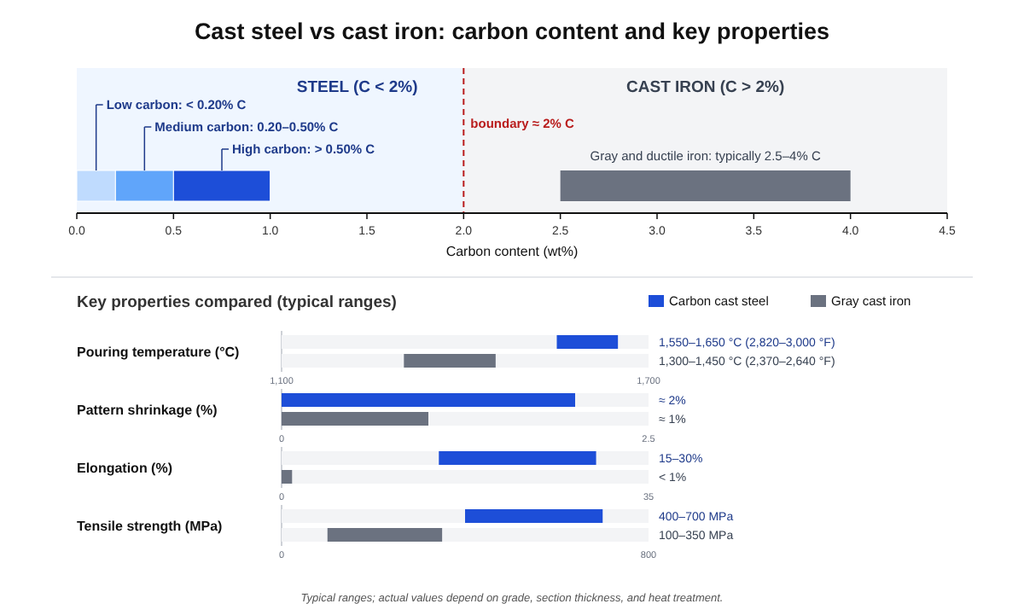
The diagram above shows the roughly 2% carbon boundary that separates steel from cast iron, and how that difference drives pouring temperature, shrinkage, and ductility. The values are typical ranges.
| Property | Cast steel | Cast iron (gray, ductile) |
|---|---|---|
| Carbon content | Below 2%, typically 0.15–0.50% | About 2.5–4% |
| Form of carbon | Dissolved in the structure (ferrite, pearlite, martensite) | Mostly as graphite (flakes or spheres) |
| Melting range | About 1,450–1,520 °C (2,640–2,770 °F) | About 1,150–1,250 °C (2,100–2,280 °F) |
| Pouring temperature | About 1,550–1,650 °C (2,820–3,000 °F) | About 1,300–1,450 °C (2,370–2,640 °F) |
| Pattern shrinkage | About 2% | About 1% (gray) |
| Fluidity | Lower; minimum wall about 5 mm | Excellent; walls down to about 3 mm |
| Tensile strength | About 400–700 MPa (carbon), over 1,000 MPa (Q&T alloy) | 100–350 MPa (gray), 350–900 MPa (ductile) |
| Elongation | About 15–30% (carbon) | Below 1% (gray), 2–22% (ductile) |
| Impact toughness | High | Low (gray), moderate (ductile) |
| Vibration damping | Low | Excellent (gray) |
| Machinability | Good | Excellent (gray) |
| Weldability | Good | Difficult |
| Cost | Higher | Lower |
Three differences usually decide the choice:
- Ductility and toughness. Cast steel bends before it breaks, while gray cast iron fractures suddenly. For parts that take impact, shock loads, or safety-critical pressure, cast steel is the safer material.
- Castability. Cast iron is far easier to cast. It pours about 250 °C (450 °F) cooler, flows better, and the graphite that forms during solidification expands and offsets shrinkage. Cast steel shrinks about 3% by volume during solidification with no such compensation, so its risers must be much larger.
- Weldability. Cast steel can be welded to other steel and repaired by welding. Cast iron is difficult to weld because its high carbon content makes the weld zone brittle.
Is cast steel stronger than cast iron? In tensile strength, ductility, and toughness, yes. An ordinary carbon cast steel is roughly twice as strong as a common grade of gray iron. In compression, however, gray iron is quite strong, and high-grade ductile iron can match the tensile strength of carbon cast steel at lower cost. For damping vibration, as in machine tool beds, gray iron is actually the better material.
The cast iron family is covered in our articles on cast iron, gray cast iron, ductile iron, and malleable cast iron.
Cast Steel vs Forged Steel
The second common comparison is cast steel versus forged steel. The chemistry can be identical. The difference lies in the structure each process produces.
| Property | Cast steel | Forged steel |
|---|---|---|
| Forming method | Poured into a mold | Hammered or pressed while hot |
| Grain structure | As-cast grains, no grain flow | Fine grains with flow lines following the shape |
| Internal defects | May contain porosity and inclusions | Porosity closed up by deformation |
| Directionality | Roughly isotropic | Best along the grain flow |
| Fatigue and impact strength | Good | Higher |
| Shape | Can be very complex, with internal cavities | Limited to forgeable shapes |
| Size | From a few grams to hundreds of tonnes | Limited by press capacity |
| Cost | Lower for complex shapes and small runs | Lower for simple shapes in high volume |
| Examples | Valve bodies, pump casings, bogie frames | Crankshafts, flanges, gears, bolts |
The rule of thumb: if the shape is complex or has internal passages, like a valve body, choose cast steel. If the part sees repeated loading and the shape is reasonably simple, like a crankshaft or connecting rod, choose forged steel. A third option is a welded fabrication from plate and sections, which is often cheaper for one or two large parts.
The Steel Casting Process
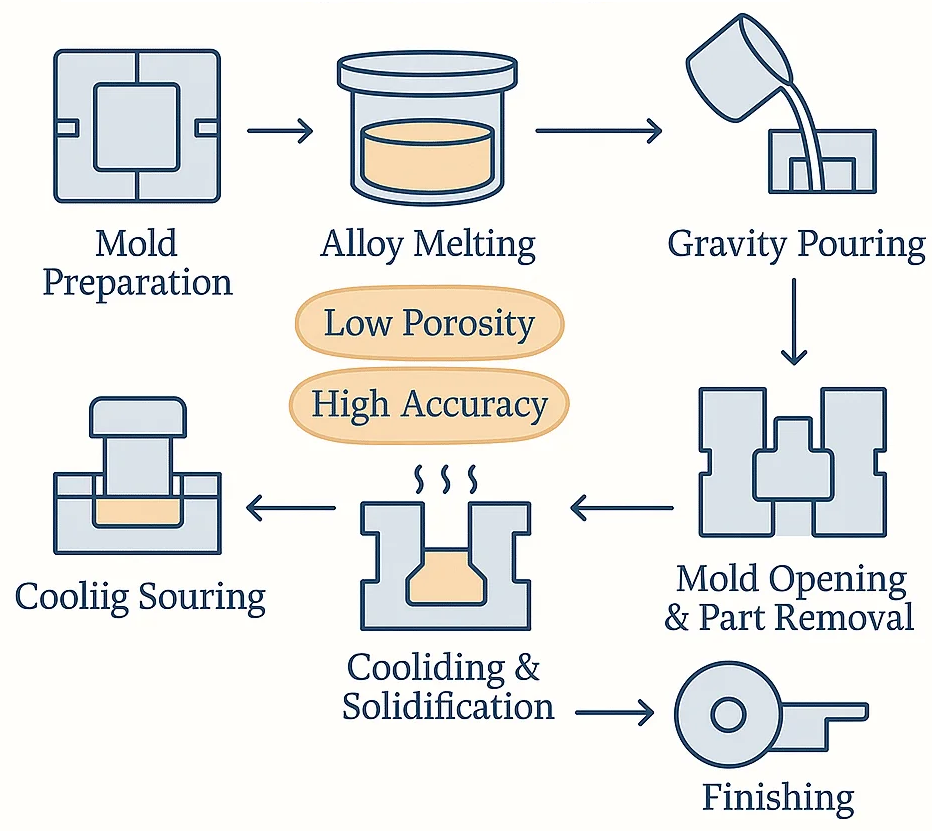
Casting steel is harder than casting iron or aluminum, mainly because of its high temperature. The steps are:
- Melting. Steel is melted in an electric arc furnace (EAF) for large tonnages or an induction furnace for smaller heats and alloy steels. Cupolas are not used for steel, because the coke adds carbon. Furnace types are covered in our guide to melting furnaces.
- Composition adjustment and deoxidation. Chemistry is checked by spectrometer and alloys are added. Before pouring, dissolved oxygen is tied up with silicon, manganese, and finally aluminum. Without deoxidation, oxygen and carbon react to form CO gas, which causes porosity.
- Molding. Most steel castings are made in sand molds. Green sand is used for small castings; large castings use chemically bonded (no-bake) sands such as furan or sodium silicate, which are stronger. Because molten steel is so hot, mold faces are often lined with zircon or chromite sand and coated with a refractory wash. See our article on sand molds.
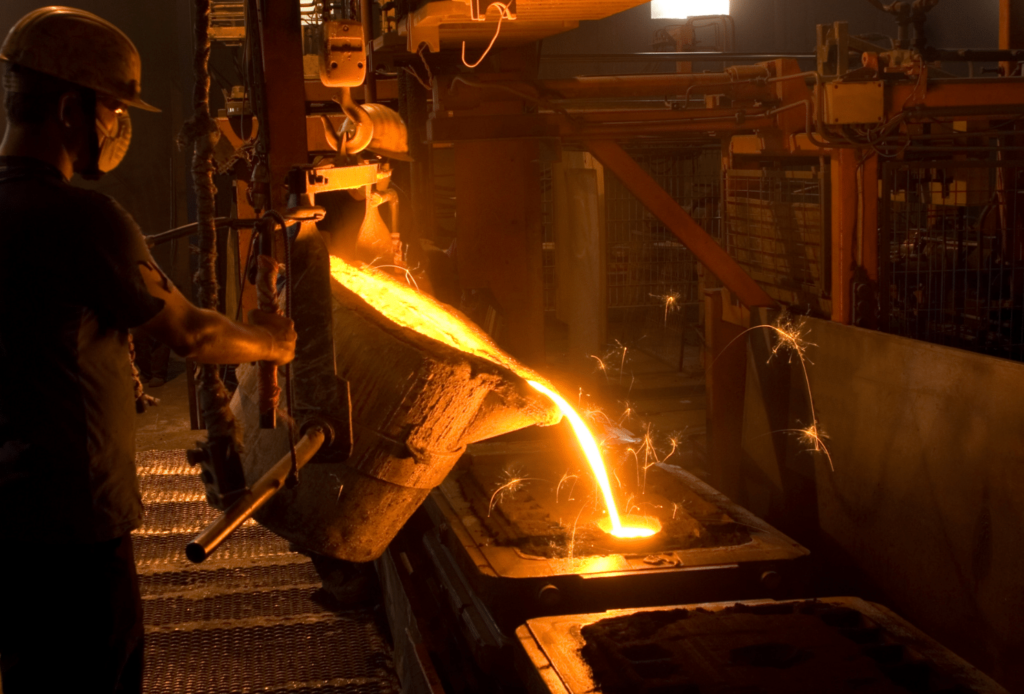
- Pouring. Steel is poured at about 1,550–1,650 °C (2,820–3,000 °F), depending on carbon content and section size. Bottom-pour ladles are common because they keep slag out of the mold. How pouring temperature affects mold filling is covered in our article on the fluidity of molten metal.
- Solidification and feeding. Because steel shrinks so much, castings need large risers, often helped by exothermic sleeves and chills. Casting yield for steel is often only about 50–65% of the metal poured. See gating and riser system design and how to calculate riser size.
- Shakeout and cleaning. Steel risers are usually removed with an oxy-fuel torch or air carbon arc gouging, because they are too thick to saw. The casting is then shot blasted and ground. See our article on fettling.
- Heat treatment. Almost all steel castings are heat treated (see the next section).
- Weld repair, inspection, and machining. Surface defects are ground out and welded, then the casting is inspected by nondestructive testing and machined.
Steel casting methods
- Sand casting: the main method for almost every size, from a few kilograms to well over 100 tonnes.
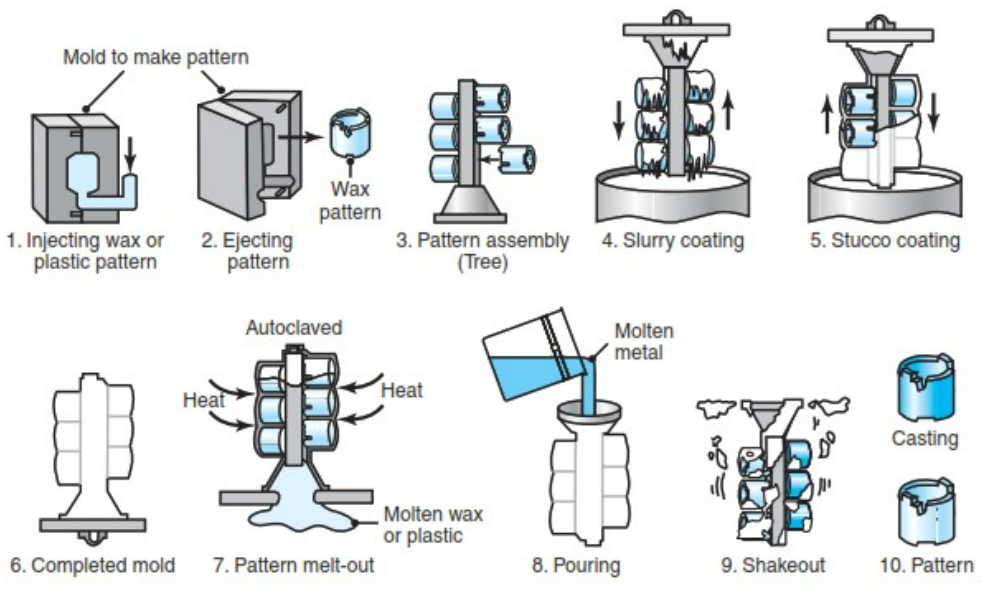
- Investment casting (lost wax): for small, precise parts, especially stainless steels such as CF8M and 17-4 PH. It gives a smooth surface and tight tolerances.
- Shell molding: for small to medium parts in larger quantities.
- Centrifugal casting: for pipe, cylinders, and rolls, with the metal spun inside the mold.
One note: steel is almost never die cast. Molten steel is too hot for metal dies, so die life is very short. These methods are compared in our article on sand vs die vs investment casting and other metal casting methods.
Heat Treatment of Steel Castings
As-cast steel has coarse grains, sometimes a Widmanstätten structure (needle-like ferrite), and segregation. This structure has limited ductility and toughness. Heat treatment fixes it:
- Normalizing: heated to about 870–950 °C (1,600–1,740 °F) and cooled in air. This is the most common treatment for carbon steel castings because it refines the grain and raises toughness.
- Full annealing: heated to the same range and cooled slowly in the furnace. The result is softer and easier to machine. See our article on annealing.
- Normalizing and tempering: normalizing followed by tempering to relieve stress and improve toughness.
- Quenching and tempering (Q&T): for high-strength low-alloy castings such as A148 grades and bucket teeth. See our article on quenching and tempering.
- Solution annealing: for cast stainless such as CF8M, heated to at least about 1,040 °C (1,900 °F) and water quenched. The goal is to dissolve carbides and restore corrosion resistance.
- Homogenizing: a very high temperature soak that evens out segregation in large alloy castings, usually before normalizing.
Other heat treatment principles are covered in our guide to metal heat treatment.
Welding Cast Steel
One advantage cast steel has over cast iron is that it can be welded. Welding is used for two things:
- Repairing casting defects. Porosity, cracks, or shrinkage cavities at the surface are ground out and filled with weld metal. For pressure castings such as valves, the procedure and welders must be qualified (for example to ASTM A488), and major repairs are usually followed by heat treatment and re-inspection. See our article on repair welding of metal castings.
- Joining castings to other steel, such as a WCB valve welded into a pipeline, or a G20Mn5 cast node welded to structural sections.
The general rules:
- Low- and medium-carbon cast steels such as WCB and SCW are generally easy to weld. Preheat is needed when the carbon equivalent is high or the section is thick.
- High-carbon and low-alloy cast steels such as WC6, WC9, and Q&T grades need preheat (for example about 150–200 °C / 300–390 °F), interpass temperature control, low-hydrogen electrodes, and often PWHT (post-weld heat treatment). See our article on post-weld heat treatment.
- Cast stainless such as CF8M is welded with matching stainless filler, without preheat, and with low heat input.
- Manganese steel has its own rules: no preheat and a low interpass temperature. See our article on manganese steel.
Typical Defects in Steel Castings
High temperature, large shrinkage, and lower fluidity make steel castings prone to certain defects:
- Hot tearing: cracks that form as the casting nears the end of solidification and is restrained by a rigid mold or core. Common at sharp corners and section changes. See our article on porosity and hot tearing.
- Shrinkage cavities: voids in the last areas to solidify, caused by risers that are too small or badly placed.
- Gas porosity: from hydrogen, nitrogen, or CO from incomplete deoxidation, and from damp molds and cores.
- Inclusions: oxides from deoxidation, slag, and entrained sand grains. See our article on inclusion defects.
- Metal penetration and burn-on: molten steel penetrates between sand grains, or sand fuses onto the casting surface, because of the high pouring temperature. Prevented with zircon or chromite sand and mold coatings.
- Misruns and cold shuts: the mold does not fill completely because the steel freezes too quickly in thin walls. See our article on cold shuts and misruns.
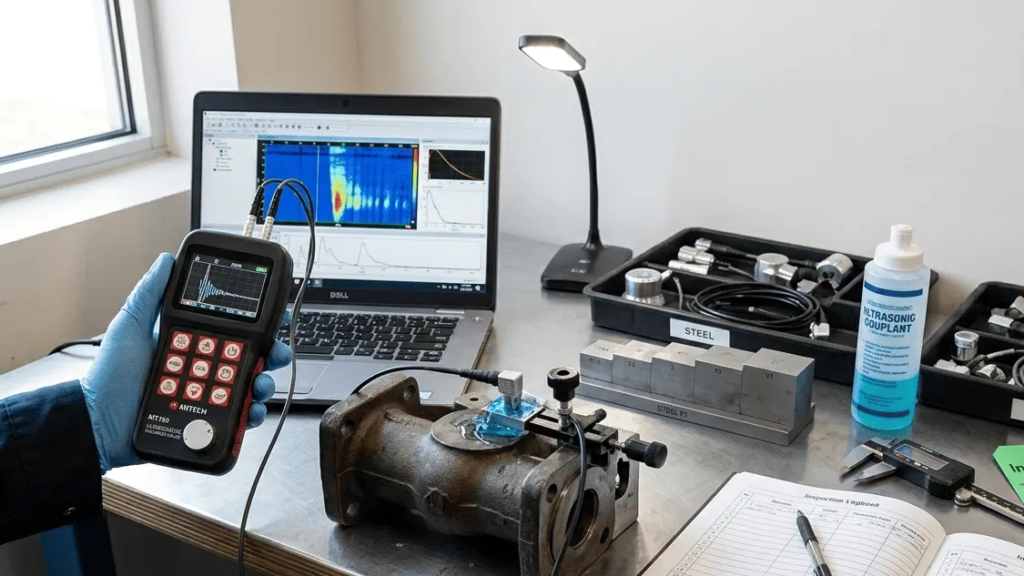
Critical steel castings are usually inspected by radiography, ultrasonic testing, magnetic particle testing, or dye penetrant. These are covered in our article on NDT methods for castings, and the full list of defects is in our guide to types of casting defects.
Applications of Steel Castings
- Oil, gas, and chemicals: valve bodies (WCB, LCB, CF8M), pump casings, and pressure fittings.
- Power generation: steam turbine casings and high-temperature valves (WC6, WC9), water turbine runners.
- Railways: bogie frames, bolsters, couplers, and wheels.
- Mining and heavy equipment: bucket teeth and lips, sprockets, crusher jaws (manganese steel), mill liners.
- Construction: structural steel nodes, bridge bearings, and tower components (for example G20Mn5).
- Shipbuilding: stern frames, rudder stocks, anchors, and propeller hubs.
- Industrial machinery: large gears, forging press frames, gearbox housings, and rolling mill parts.
- Automotive: turbocharger turbine housings and exhaust manifolds in heat-resistant steel.
When to Choose Cast Steel, Cast Iron, or Forged Steel
- Choose cast steel when the part is complex or large and must withstand impact, pressure, or extreme temperatures, or has to be welded to other structures.
- Choose cast iron when the part is loaded mainly in compression, needs to damp vibration, or must be cheap and easy to machine, such as engine blocks, machine tool beds, and small gearbox housings. Ductile iron is often a cheaper alternative to carbon cast steel.
- Choose forged steel when the part sees repeated fatigue loading and the shape is simple enough to forge.
- Choose a welded fabrication when the part is large, only a few are needed, and it can be built from standard plate and sections.
Design rules that make castings easier to produce are covered in our article on design for castability. For a general guide to choosing casting alloys, see our article on casting material selection.
Frequently Asked Questions
What is cast steel? Cast steel is steel with less than 2% carbon, typically 0.15–0.50%, that is shaped by melting it and pouring it into a mold. It combines the shape freedom of casting with the strength, ductility, and weldability of steel.
What is the difference between cast iron and cast steel? Cast iron contains about 2.5–4% carbon, mostly as graphite, while cast steel contains less than 2%. Cast steel is stronger, much more ductile, impact resistant, and weldable. Cast iron is easier to cast, cheaper, easier to machine, and better at damping vibration.
Is cast steel stronger than cast iron? In tensile strength, ductility, and impact resistance, yes. An ordinary carbon cast steel is roughly twice as strong as a common grade of gray iron. High-grade ductile iron can match the strength of carbon cast steel, but its ductility and weldability still fall short.
What is ASTM A216 WCB? ASTM A216 WCB is a weldable carbon cast steel for pressure-containing parts, with a maximum of 0.30% carbon, a tensile strength of 485–655 MPa (70–95 ksi), and a minimum yield of 250 MPa (36 ksi). It is the most widely used material for valve bodies in service from about −29 to 425 °C (−20 to 800 °F).
Can cast steel be welded? Yes. Low- and medium-carbon cast steels such as WCB are generally easy to weld. High-carbon and low-alloy cast steels need preheat, low-hydrogen electrodes, and often PWHT. Welding is also used to repair casting defects under a qualified procedure.
Related Articles
- Choosing Materials for Metal Casting: Cast Iron, Cast Steel, and Aluminum Alloys
- Manganese Steel (Hadfield Steel): Composition, Properties, Casting, and Uses
- Gray Cast Iron: Microstructure, Grades, Properties, and Uses
- Casting Defects: Porosity and Hot Tearing
- Gating and Riser System Design

Dagus R. Djuanda is a metallurgical engineer with more than 20 years of experience in materials engineering, specializing in magnetic materials. He holds a master’s degree in magnetic materials engineering, is a doctoral candidate in industrial engineering, and works as an engineer at the Ministry of Industry of the Republic of Indonesia. Founder of Metalurgika.